Showing posts with label furniture. Show all posts

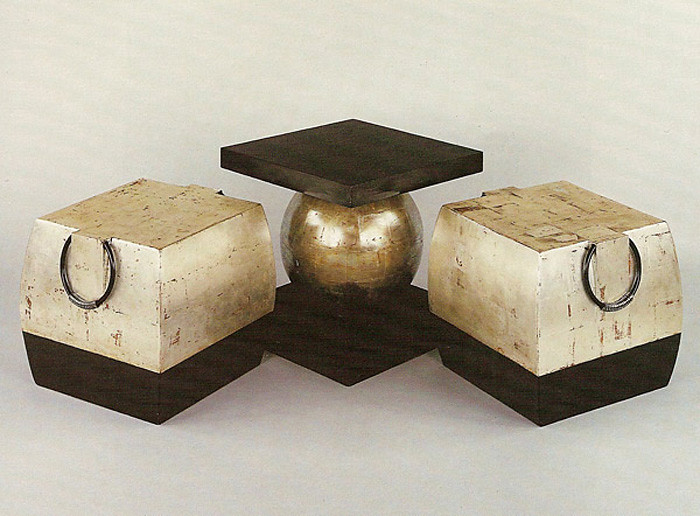
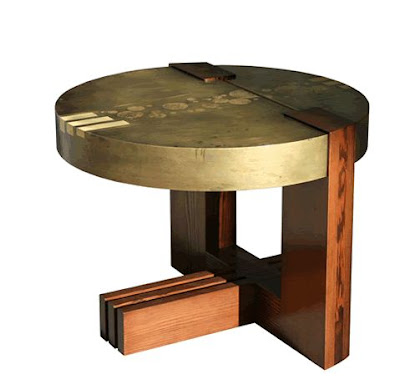
Pierre Lagrain 1889-1929.

"There were always golden rocks to throw
At those who admit defeat too late
Those were our times, those were our times"

- Beirut


"The times we had
Oh, when the wind would blow with rain and snow
Were not all bad
We put our feet just where they had, had to go, Never to go...."


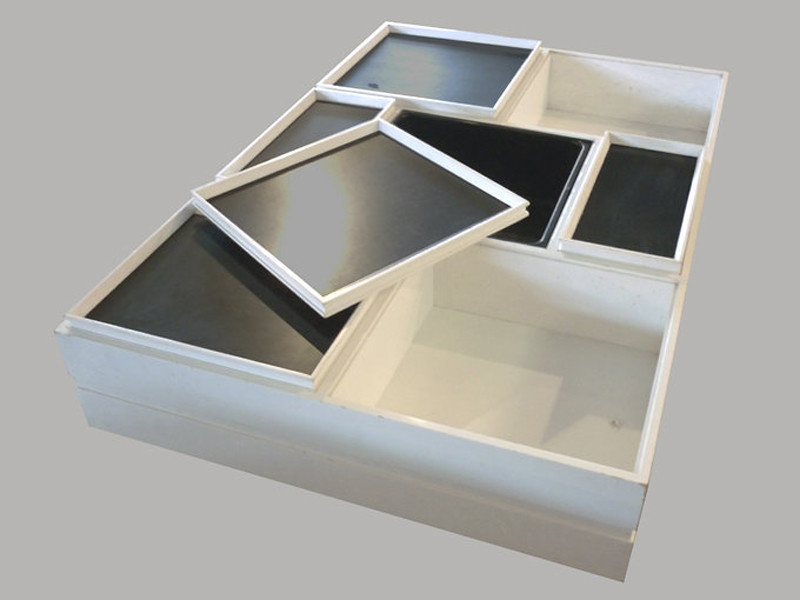
2 side tables + stools.
(top image by Pierre Lagrain, 2nd image in the style.)


"
Pierre Legrain’s name cannot be dissociated from the rebirth of modern bookbinding. Needless to say, it must be remembered that it was at the instigation of Jacques Doucet that the draftsman and designer unexpectedly found himself engaged in the art of bookbinding. Other than the diversity of his gifts, his culture and his avant-garde spirit nothing seemed to have prepared him for this undertaking.

Pierre Legrain’s décors are almost always abstract and linear, with the letters of his book titles often serving as the ornamental motif. But notwithstanding their appearance of freedom, his compositions are conceived with an architectural rigor. Abandoning the customary browns, reds and greens that prevailed in bookbinding, Legrain employed leather as well as unexpected materials with unusual, light tones whose delicate, refined harmonies complemented the purity of his rhythms. His work was a stunning success and whilst the adventure lasted only a dozen years, Legrain left a decisive mark on the art of bookbinding. His influence continues to persist. Moreover, his activities as a decorator cannot be forgotten. At the same time he was working for Jacques Doucet, Jeanne Tacharp commissioned Legrain to refurbish her Paris home and her villa in La Celle-Saint-Cloud. Everything from the doorlocks and lighting, to the furniture, silverware and even the garden revealed the design of a book binder; the leather representing grass and the mosaics in flowers. All of it had been created by Legrain."


(biographical text taken from here)


-----------------------------
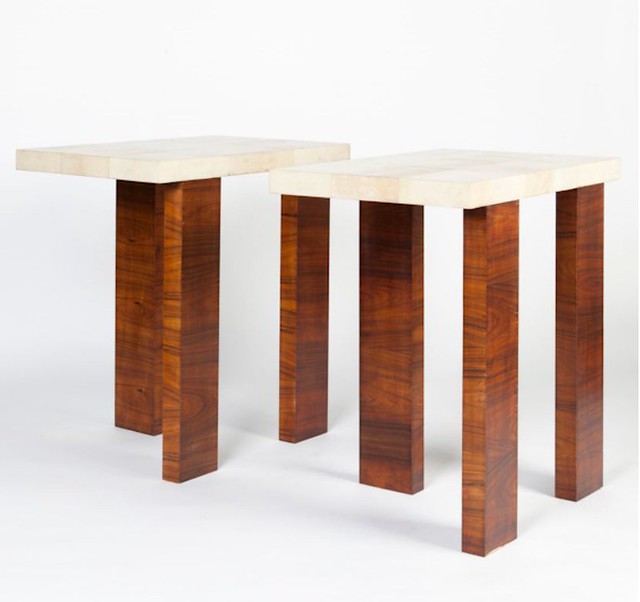

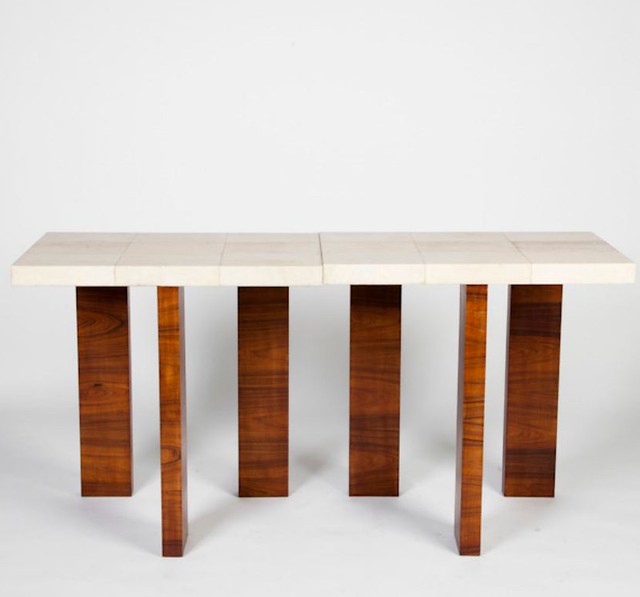
custom tables by eccola


"On your back with your racks as the stacks as your load

In the back and the racks and the stacks of your load
In the back with your racks and you're unstacking your load"


"tre gambe console, parchment top with pallisander veneer base"


"Eccola is Italian for "here it is" and it is the eponym of this Hollywood showroom that is filled with eclectic imports, Italian modern and a smattering of custom contempoarary pieces.

The merchandise in-cludes pieces by Gio Ponti, Franco Albini and Osvaldo Borsani, as well as Italian and Spanish foosball tables from the 1950s and Soqquadro tables by the architect Raniero Aureli.


Husband and wife team Maurizio and Kathleen Almanza take regular trips to their house in Rome, which they use as a base, to scour the continent for unique antiques, accent pieces and architectural elements.

Kathleen White Almanza, a former Hollywood set designer, has long called Italy home and knows how to find every fabulous flea market and estate sale. Don't expect a typical dusty antique shop: Eccola stocks extraordinary centuries-old pieces but also gives a whimsical nod to modern design.
"


Eccola
7408 beverly blvd
los angeles, ca 90036

lyrics by bon iver.
(june gloom in full effect here in los angeles.)


-----------------------------------------


-----------------------------

Blackman Cruz Workshop

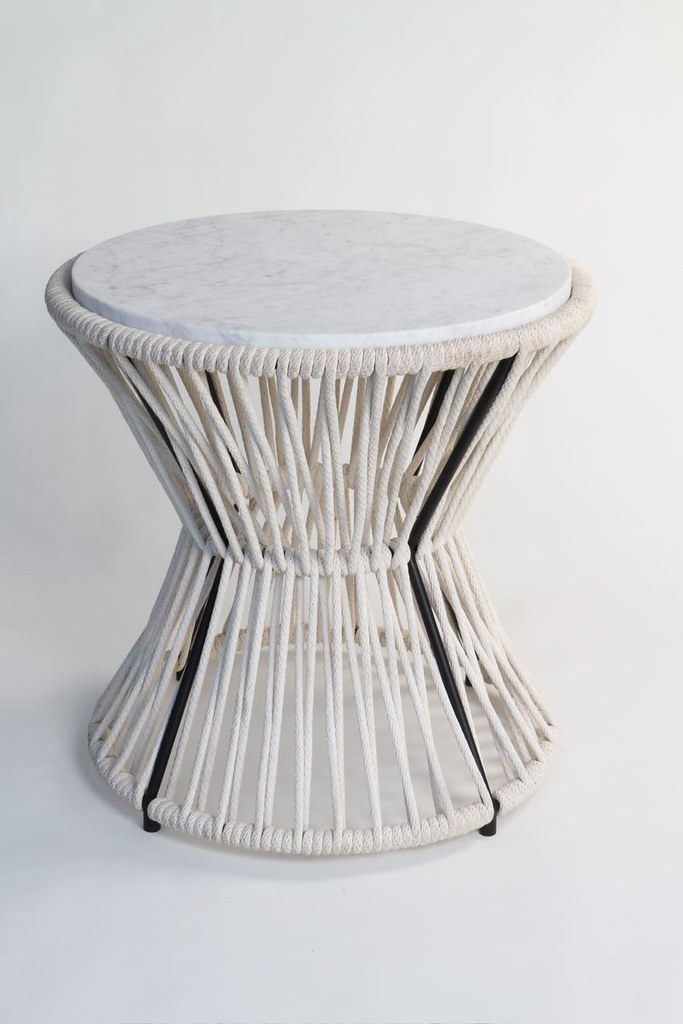
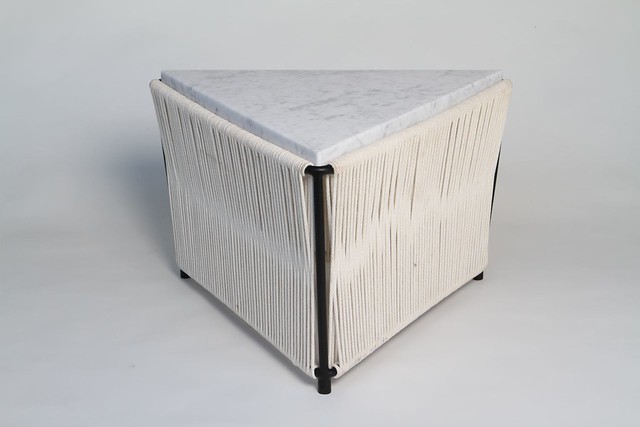
2 new works by Lika Moore.

Blackman Cruz Outdoor Line

Cotton sashing, iron, and honed Carrara marble, plus lots more......


2 new works by Lika Moore for

Blackman Cruz Outdoor Line


Um, perfection, right? Wow, the new Blackman Cruz Outdoor Line is nothing short of spectacular. Upon first glance at their new line, these two tables designed by Lika Moore stole my heart. Pure geometry, sharp lines that fade into marble.... They make me think of an Anthony Caro sculpture or a Sol LeWitt drawing come to life.

But to be fair, every piece I've seen including the rocker and the lounge chair are sublime. Welcome home to summer.


Cotton sashing, iron, and honed carrara marble.

go to Blackman and Cruz for more info...
also read YHBHS interview with them here from a few months ago...


------------------------


if in doubt, look to the grid
aka
buildings eventually become furniture


if in doubt, look to the grid
aka
buildings eventually become furniture


1. Carlo de Carli, 1941
2. Pierre Jeanneret and A.R. Prabhawalkar
3. Converso, Mod Poster Bed


"Pierre Jeanneret (2 March 1896, Geneva - 4 December 1967) was a Swiss architect who collaborated with his more famous cousin Charles Edouard Jeanneret (who assumed the pseudonym Le Corbusier) for about twenty years. Their working relationship ended when Pierre joined the French Resistance and Le Corbusier did not. However, they collaborated once again and famously after the War, on the plan and architecture for the planned city of Chandigarh in India."


----------------
investigation of form
and materials.


investigation of form
and materials.


1. Philippe Hiquily, beaten brass seat chair.
"Starting from 1960, he created furniture. The creation of bronze began around 1980. They were exposed for the first time in 1986 at the Galerie Patrice Trigano in Paris.
The sculptures of HIQUILY are characterized by a pervasive eroticism, that translates into a smooth universe filled with elements borrowed from nature (antennas, horns, insect legs ...). The search for formal balance is obvious. " taken from here...


2. Folkform lamp:
"Stockholm-based
FOLKFORM is a design studio owned and run by industrial designers Chandra Ahlsell and Anna Holmquist. They work on their own independent collections as well as with clients."


-----------------------------

YOUTH FOREVER

it's not what you lost, but it's what you find.

2011 vs 1720 (pick the flowers, young children...)


it's not what you lost, but it's what you find.


images.
1.
ERIK WYSOCAN
(A Vase of Flowers and Two Plums on a Marble Tabletop, A Vase of Flowers and Two Plums on a Marble Tabletop)
2. "Painted on all surfaces with exquisite floral still lifes, this extremely rare cabinet on stand epitomizes the highest quality among painted furniture in Holland and England of this period."
via Koller Auctions. Unknown cabinet maker.... 1700 1720 circa


partial lyrics by ellie goulding.


---------------------------------
Y H B H S (card catalog) selection 30

IKO IKO & WAKA WAKA,
Echo Park
"
There are so many examples of the tension in positive - negative space as well as the limitlessness of brush, ink, gesture and accident."


IKO IKO
IKEBANA by Sofu Teshigahara
with photos by Ken Domon, 1952.


"This book was given to me by a friend when I was taking ikebana classes. It's a diverse sampling of the art of Sofu Teshigahara, the founder of the Sogetsu School of Ikebana. It's all about the range of self expression with flowers as the medium and is my personal inspiration bible. So many incredible combinations of texture, palette, geometry, and feeling. I like that you can designate a kind of personality to the flowers in his arrangements."


WAKA WAKA
Shohaku Show, Kyoto National Museum, 2005.


"This is the publication from the exhibition which I happened upon during a visit to Kyoto. There are so many examples of the tension in positive - negative space as well as the limitlessness of brush, ink, gesture and accident. It's inspiring to see the technical maturity of an artist in this way."


"The Shohaku Show explores the life and works of the iconoclastic Edo-period painter Soga Shohaku (1730-1781), who has long been believed to come from the province of Ise. His many works in this area even today appear to confirm this. However, records indicate that from his father's generation the family lived in Kyoto, where many eminent painters, including Yosa Buson, Ike no Taiga, Maruyama Okyo, Nagasawa Rosetsu, and Ito Jakuchu, were active. Ranking in line with such figures, Shohaku developed his own distinctive style by deviating from the contemporary art scene and professing to the then outdated style of the Muromachi (1392-1572) painter Soga Jasoku (d. 1483), undoubtedly in an attempt to undermine the overwhelming popularity of the realist painter Maruyama Okyo (1733-1795)."

(taken from here.)


--------------------


IKO IKO is Kristin Dickson's fantastic store located in the heart of Echo Park, Los Angeles. It's chock-full of art, ceramics, textiles, fashion, photography, and items she has sourced from the U.S and Japan. I'd suggest getting on her email list so that you are informed of the events at IKO IKO! Go to her blog here if you aren't local...


WAKA WAKA is Shin Okuda. He has been designing and building custom furniture under the WAKA WAKA name for the past few years in Los Angeles. WAKA WAKA is also sold at IKO IKO. YHBHS interviewed Shin about his work last year, his inspiration, and future plans for his work. Read the full interview here..


----------------------

Y H B H S (card catalog) selection 4

Jason Roskey, furniture designer, Fern NYC


The Catalog of Robert Rauschenberg's 1970 show - Currents


Jason Roskey
writes, "I picked up this catalog of Robert Rauschenberg's 1970 show - Currents: Dayton's Gallery 12, Minneapolis - from Village Books in Tivoli, New York a few years ago. The show consisted primarily of collages and silkscreens of then present-day newspaper clippings. The onslaught of visual information is remarkable, and while this body of work isn't as relevant and well-known as his "combine pieces", it still manages to resonate in the same way."


-------------


"To create these works, Rauschenberg first juxtaposed and overlapped imagery appropriated from photographs, scientific diagrams, newspapers, and popular magazines. In two of the series, he unified his collaged designs with scrawled drawing and animated brushwork. The provocative collisions of images and ideas are layered in meaning, reflecting the energetic rhythms and contradictions of the country at a critical point in its history. "


-------


Fern
is a Brooklyn-based furniture company crafting heirloom quality furniture from American hardwoods, reclaimed antique timbers and salvaged objects. The company strives to create contemporary yet timeless designs using sustainable practices whenever possible. Fern also provides design services and produces sculptural objects in limited editions.

Fern was founded by Jason Roskey and Maggie Goudsmit in 2009.


go to Fern's site here..
read an interview with Jason here from YHBHS.


---------------
sybarite's "shuttlecock" table
vs.
scott burton's picnic table
vs

brancusi's " table of silence"


cosmic dining pt 1.


Anyone who knows me, knows that Scott Burton's concrete forms quicken my mellow pulse. A rush and a push!
Such mass and simplicity simply sends shivers up my spine! I recently found this picture on a random flicker account, labeled the "picnic table" by Scott Burton.

Perhaps I've spent too many summers at Burning Man, and full moons at Joshua Tree, but this table just seems cosmic in every sense of the word. I ask you, have you ever seen a picnic table as cosmic as this? This is a table that Felix Gonzales Torres or even Maya Lin would covet. I'm not quite sure what sort of chairs/stools one might use, but is that really that important?


Roberta Smith, who wrote this beautiful piece when Soctt Burton passed away....

"Mr. Burton worked in a tradition of utilitarian modernism that started with the Russian Constructivists and was continued by the De Stijl and Bauhaus artists. His greatest achievement may lie in his forays into public art, which evolved in accordance with his belief that art should ''place itself not in front of, but around, behind, underneath (literally) the audience.''

"
His fiercely laconic work destroyed the boundaries between furniture and sculpture, between private delectation and public use and radically altered the way we see many 20th-century masters, including Gerrit Rietveld and Brancusi.''

Mr. Burton's own sculptures, which could be used as tables and chairs when they were not on exhibit, often infused the plain abstract forms of Minimalism with a sense of utility, history and wit. To accomplish this, the artist drew on his wide knowledge of furniture - a passion since childhood -both modernist and vernacular, 19th and 20th century.


Sybarite Architecture...
London townhouse.

more cosmic dining, this time indoors please.
No chairs needed!


-----------


"International architecture and interior design firm Sybarite recently completed a complete refurbishment of a four bedroom Victorian townhouse in West London's Brackenbury Village.

On the lower ground floor, an open plan kitchen, dining room and play room form the basis of the space, whilst a round hatchway concealed behind the kitchen leads down to a sizable wine cellar. Bright yellow liquid laminate cabinets adorn the large kitchen, whilst the dining room is dominated by a gravity defying ‘shuttlecock' dining table."


Constantin Brancusi

"The Table of Silence"
Targu-Jiu, Romania


I'm off to find more about this sculpture table!


"The Table of Silence is made in limestone and it has the following dimensions: panel diameter 2, 15 meters, thick 0,43 m and the leg is 2 m in diameter and 0,45 m thick. According to the exegetes of the Brancusian art, the Table of Silence represents the table around which gather the soldiers before confronting their enemy.

At the same time, the chairs stand for the time disposed in hourglasses. Some make an analogy with The Last Supper of Leonardo da Vinci.
"


sybarite's "shuttlecock" table
vs.
scott burton's picnic table
vs

brancusi's " table of silence"


cosmic dining pt 1.


--------------------------
the
french
empire.
(green this time)


Empire style is originally the elaborate Neoclassical style of the Napoleon's French First Empire (1804-1815). Roman-inspired symbols, furniture, and even hairdos were part of an ambitious scheme to relate Napoleon to Emperor Augustus as the French government was transformed from a republic into an empire.

There is no distinct Empire style of architecture.

The style was largely inspired by Napoleon's architects Percier and Fontaine.


Napoleon's green room


In 1798, Napoleon returned triumphant from his Egyptian campaign. The victory launched a program of intense scientific research, prompted by the large numbers of archaeological discoveries collected in Egypt by the throng of scholars accompanying the expedition. The worlds of fashion and the applied arts also took up the Egyptian theme, with motifs such as sphinxes, winged lions, lotus blossoms, caryatids and scarabs appearing everywhere. All over Europe, Egyptian motifs, as well as those drawn from Ancient Greece and Rome, were to become prominent features of the sumptuous Empire style of decoration.


-----------------------------
ROLU
studio!

“field recordings”
made of wood.


New work by Rolu Studio!

"inspired by 70s DIY books, the ideas proposed in Enzo Mari's Autoprogettazione project, Judd, Reitveld, Burton and Schindler."


Upcoming interview with Matt, from Rolu Studio on YHBHS, very soon! These guys continue to amaze me with their blog, their landscape and art studio based in Minneapolis, and now a line of furniture. Not sure where they find the time, but sure happy they do! Congrats Matt and Mike on your new project....


---------------------
Simon Hasan:
Cuir Bouilli

"Boiled leather,
mirror polished brass,
linen thread.."


Cuir Bouilli

"Boiled leather, sometimes called cuir bouilli, was a historical construction material for armour. It consists of thick leather, boiled in water (some sources hold that oil and wax were used as well, others posit the use of ammonia from fermented animal urine.

The boiling causes the leather to be harder and more brittle. The boiled leather can be fashioned into lames/scales to make lamellar or scale armor. Or, because the leather remains flexible for a short time after boiling, it can be molded into larger 'plates'. Cuir bouilli has also been employed to bind books."


------------------------
Mario Dal Fabbro 1913-1990
3 pieces
of furniture.


Born in Italy in 1913.

"MARIO DAL FABBRO studied both at the R. Superior Institute for Decorative and Industrial Arts at Venice, and the R. Magistero Artistico. He graduated with high honors in 1937. Before his advanced education, Dal Fabbro worked in his family's furniture design shop.

Always able to combine the theoretical with the practical aspects of construction, Dal Fabbro's early experience helps account for his later success in the technical and creative fields of furniture design. Between 1938 and 1948 -- before immigrating to America -- Dal Fabbro created designs for private individuals and various furniture houses in Milan.
"


Mario Dal Fabbro 1913-1990
3 pieces of furniture.


--------------------------------
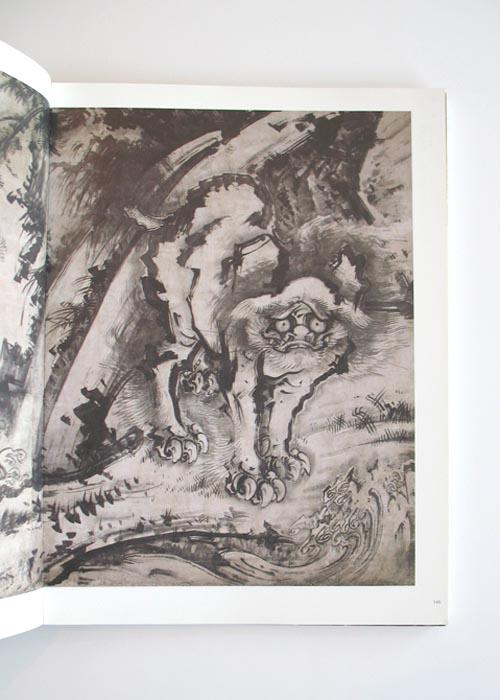


3 stools

Howe London
93 Pimlico Road London


“I studied as a sculptor therefore form and texture are primary. Design must be pure and have great qualities which achieve timelessness. I want my furniture to survive and be appreciated for a long time, like the antiques I also sell. I love research and academic discoveries which tell you more about a piece, but the mood created by the design, scale, colour or condition is what really inspires me.”

Christopher Howe


"Christopher’s career has been a fascinating one; in 1986, having just left Goldsmith’s College of Art, he took on a derelict shop in a small street in Belgravia. It opened with a small loan and stock found in markets and borrowed from friends, relying only on candles for lighting. A year on, after some building work the shop re-opened with a window displaying a Gae Aulenti lamp and a pair of Pierre Paulin white vinyl Tulip Chairs, an innovative style which has remained the essence of Christopher’s approach to antique dealing ever since."


go here to see the entire collection.
stunning and timeless...


-------
two
tables
(play)
for
today.


brass & doug fir. side table


reclaimed oak

finished with eco hard wax oil
steel


Tables on the top of my list.

1. Studio Roeper, here...
2. Pacha Design, here.


--------------------

Gaetano Pesce!

Gaetano Pesce gives a talk at Hammer Museum, Los Angeles.
And his retropsective opens in Los Angeles the same evening!


Just found out that Gaetano Pesce is giving a lecture at the Hammer Museum next week!
And the
opening of a retrospective of his work at the Italian Cultural Institute of Los Angeles.

Anyone going, drop me an email.....?


The first retrospective in the Western United States of architect, artist, designer Gaetano Pesce celebrates the maestro of art-design and his years of experimenting and creating works with polyurethane foam, resin, and plastics for such A-list companies as Cassina, B&B Italia and Meritalia.

Works on display include prototypes, production models, video, and audio produced throughout Pesce's 40-year career.


Gaetano Pesce
Co-presented with Istituto Italiano di Cultura.


Internationally renowned architect and designer Gaetano Pesce was born in 1939 in La Spezia, Italy, and studied architecture at the University of Venice. He has designed for companies such as Cassina, B & B Italia, Bernini, and Knoll International. His architectural work includes the Organic Building of Osaka, the Children’s House for Parc de la Villette, the Gallery Mourmons in Belgium, and the office for the New York advertising of agency TBWA\Chiat\Day. Pesce received the prestigious Chrysler Award for Innovation and Design in 1993 and the Fashion Institute of Technology’s Lawrence J. Israel Prize in 2009.


-----------------------------

Scott Burton

taken from NY TIMES,
an obituary by Roberta Smith.

Jan 1, 1990.


Scott Burton, an American sculptor whose work balanced stubbornly and elegantly between art and furniture while evolving into a new kind of public sculpture,
died of AIDS on Friday at Cabrini Medical Center in New York City.

He was 50 years old and lived in Manhattan.


By the end of his life, Mr. Burton's simple yet eye-catching benches, stools and chairs, cut from smooth and sometimes jagged pieces of granite, could often be found with people sitting on them in several North American cities, including Seattle, Cincinnati, New York City, Portland, Ore., and Toronto.

---------


Mr. Burton, a small, wiry man known for his erudition, verbal precision and explosive laugh, worked as a critic and an editor for Art News and Art in America before becoming a full-time artist. He emerged in the late 1960's and early 70's as part of an artistic generation that came of age in the shadow of Minimalism.


Uncertain that his passion for furniture and design could ever lead to an artistic career, he turned to literature, obtaining an B.A. from Columbia in 1962 and an M.A. from New York University in 1963. By the mid-60's he was working regularly as a freelance critic for Art News, then under the editorship of Thomas B. Hess.

Elizabeth C. Baker, the editor of Art in America and formerly the editor of Art News, worked with Mr. Burton at both publications. ''As a critic his enthusiasms were passionate, his dislikes were categorical,'' she said. ''He wrote as he would later cut granite, with high style, great clarity of form and a very sharp edge.''


At the end of his life, Mr. Burton's interests in dissolving the boundary between art and design took him into the curatorial realm. Last spring, at the invitation of Kirk Varnedoe, the director of the department of painting and sculpture at the Museum of Modern Art, he organized an exhibition of Brancusi's works at the museum.

In it, some of Brancusi's bases were exhibited on their own, as sculptures in their own right, a treatment that outraged some critics, while impressing others.


The art historian Robert Rosenblum said of him yesterday: ''Scott was as singular and unique as a person as he was as an artist. His fiercely laconic work destroyed the boundaries between furniture and sculpture, between private delectation and public use and radically altered the way we see many 20th-century masters, including Gerrit Rietveld and Brancusi.''


-------------------------------
Paul Mathieu


"French designer, Paul Mathieu, based both in New York and Aix-en-Provence, exhibits his signature style in his furniture collection for Ralph Pucci International.

Mathieu is a progressive designer who gained his reputation through both his international interrior design projects, as well, as, his product designs for companies such as Ecart.

An unmistakable benchmark is evident in the graceful and elegant modernism infused in Mathieu's work. His furniture combines the unassuming harmony of nature, blending sinuous curves with tailored geometry. Mathieu's designs combine richness and depth of woods with the comfort of upholstery and with detail. This results in a refined statement of clean, luxurious simplicity."

via ralph pucci

The Folding Walls!

screens screens
we
all screen
for more screens.


-- -- -- --


Lately, Ive become fascinated with screens, as
sculpture, as energetic divides into space, and as an element in a room.
Don't want to build a wall, then get a screen!

Function + Beauty + Ability to Fold =
Hells yes!
Just as Anne Truitt built columns, or sculptural voids in the form

of rectangles to the sky, these collection of artists, architects, and designers
are taking the idea of a traditional screen and making it their own.

Are they paintings that fold, or painted sculptures that slink on the floor?
Or possibly mere decoration, ugh I'm not even sure anymore.
Call them what you will, or just unfold one in your colonial living room, or private
white-walled modern gallery, or just simply stare at them on this screen like me.
Enjoy.


-- -- -- -- --


Untitled
, 2008
Wood, stain, cotton


SHUTTER
Screen Printed Sand-washed Silk Lacquered Mahogany


silkscreen on wood
2009


"Each piece is made from Hinoki (Japanese Cypress), an elegant and pleasantly scented wood that is highly rot-resistance and does not require any additional oils or waxes. Hinoki is the most luxurious wood used in the craft of Tategu."


The Folding Walls!
screens screens
we
all screen
for more screens.


1. Egon Eiermann: dark green screen. A functionalist, and an architect. 1904 - 1970.
2. Eva Berendes. Her work haunts me on so many levels.
3. India Carpenter. Read my interview with her here, and see more of her work.
4. Scheltens Abbenes, read more here.
5. BCXSY. I first read about these guys at SightUnseen. Take a look at their article here! A cooperative between designers Boaz Cohen and Sayaka Yamamoto. BCXSY is a multi-disciplined experience that creates and develops concepts, identities, products, graphics, interiors and atmospheres.


-------------------------