Showing posts with label wood. Show all posts
Y H B H S (card catalog) selection 29

Gerard O'Brien,
REFORM, Los Angeles
"The book inspires me because it is one man’s narrative about his choices with life. The house was the purist expression of that. "

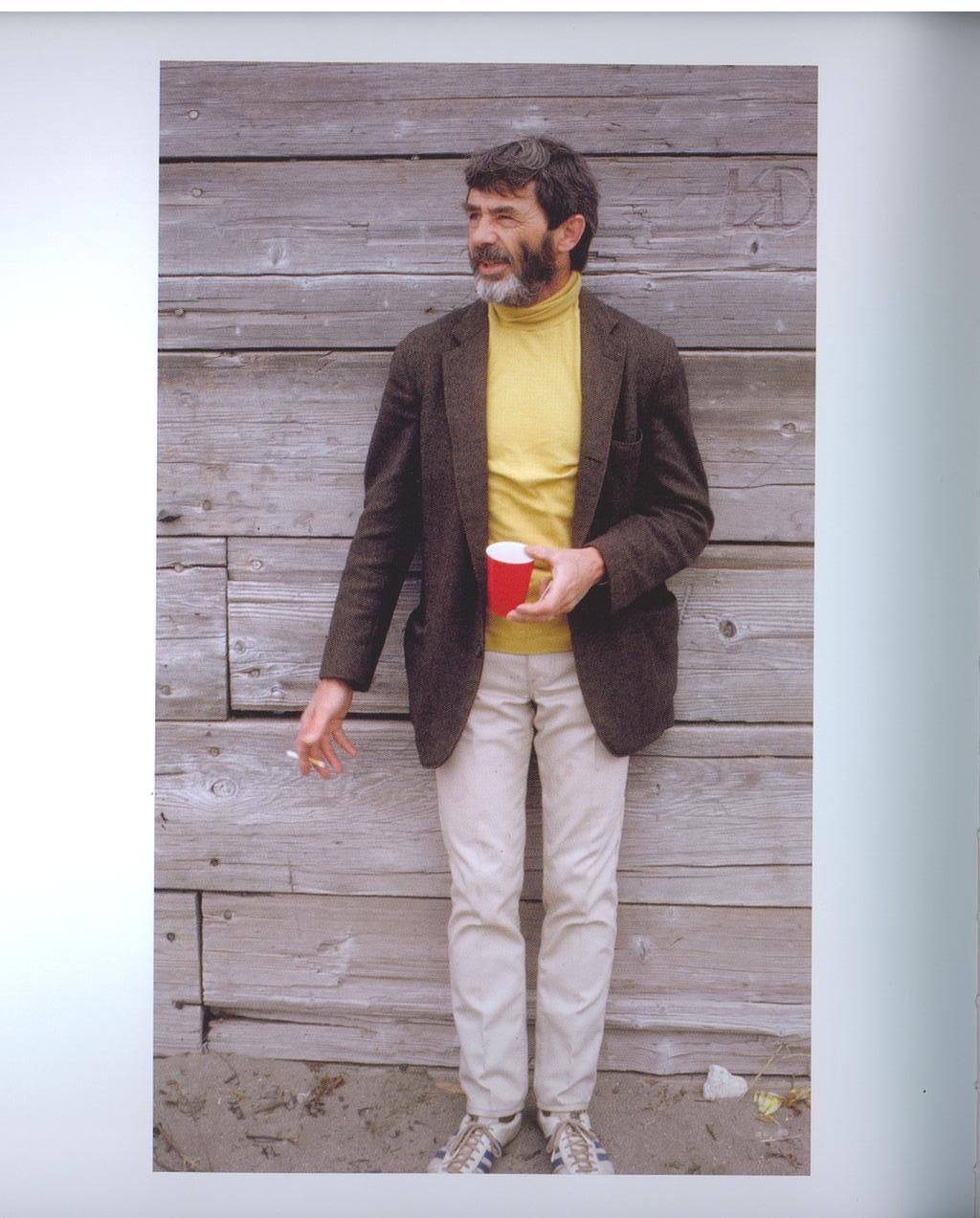


Arthur Espenet Carpenter: Education of a Woodsmith
by Art Carpenter; edited by Tripp Carpenter and Linda Moore


Gerard O'Brien
, from REFORM, writes "I just got back from San Francisco, where I was for the holiday. I was lucky enough to also get at chance to go up to Bolinas yesterday and see the Carpenter Round House in the flesh for the 1st time. I had been lucky enough to visit with Art while he was still alive, and been fortunate to handle a number of his important pieces.
If not for Art, I would have never gotten to work with the Blunk estate. It was while attending his memorial service in ’96 that I made the connection that led me to work with the Blunk estate.

Art’s honest narrative of his own choices in life, and the images of his work that accompany it are truly inspiring for me. The book inspires me because it is one man’s narrative about his choices with life. The house was the purist expression of that. "


"A prominent figure in 20th century American furniture design, Arthur “Art” Carpenter (1920-2006) combined great creativity with obsessive pragmatism, helping originate the distinctive California Roundover style.

In this book, twenty years in the making and completed in the last year of his life, Carpenter reflects on his extraordinary career. He discusses his influences, including Western and Asian furniture traditions, modern art, and organic forms of nature, and articulates his philosophical approach to design and workmanship. Filled with personal anecdotes and hundreds of photographs that Carpenter took over a 50-year span, the book's chapters have titles ranging from “Wood”, “Tools” and “Chairs” to “Beauty”, “Metaphor” and “Bohemian Economics”. (from here)


---------------


REFORM: Gerard O’Brien tells stories about post war California Modernism and the artists / craftsmen that have called the West Coast their home and inspiration. Take a wander into his L.A. Melrose store, REFORM, and get lost in works made in wood, ceramics, glass, and textiles. It's likely you'll see work by Peter Voulkos, Paul Tuttle, Gerald McCabe, Evelyn Ackerman, and J.B. Blunk!

6819 Melrose Ave,
Los Angeles CA 90038
323.938.1515
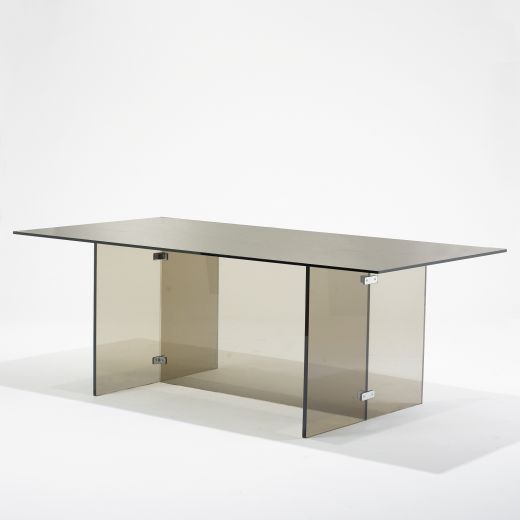

Portrait of a Dining Table.

"the holiday edition"

1970-2010 (slate, wood, glass, & marble)


Portrait of a
Dining Table
.

"the holiday edition"

1970-2010 (slate, wood, glass, & marble)


1. In the manner of Pierre Cardin, 1970

2. Delfi Vetro, Marcel Breuer - Carlo Scarpa - Tobia Scarpa 1969/2009 Ultrarazionale collection Evolution of Delfi table, realized in 2009 rielaborate by Tobia Scarpa, this table is composed by two monolithic bases made with White Gioia carrara marble or with White Vicenza stone and by a top in crystal fixed to them with brass plates and nylon supports.

3. Joaquim Tenreiro (1906-1992)" is the pioneer of modernist Brazilian furniture making. A forerunner in the use of rediscovered raw materials as well as the creator of a new formal language in 20thcentury Brazilian furniture design, he drew on the lessons of past furniture making as a vital source, not only in the mastery of technical and constructive solutions, but also in the aesthetic experience, craftsmanship, and the cultural meaning of his production. His exquisitely crafted pieces evoke a refined coexistence of traditional values and modern aesthetics, strongly bound to the Brazilian cultural milieu." more here.

4. B and B 1980's

5. Sawkille, Byrdcliffe Patio Table. go here...

6. Sebastian Matta, carved wood, 1970's.

7. Pacha Design Oak edge oak & slate dining table with benches. Reclaimed & sustainably sourced U.K. oak finished with eco hard wax oil cornish slate! New work coming soon!


--------------------------


Parallel
Occurrences


Bernd Lohaus 1940–2010


“For the last twenty-one years, I have been working on a self portrait in the form of a building. The building is fiction, but everything inside exists in reality. The building is like a gigantic stage set frozen in time with lots of rooms that all seem as if they have just been abandoned. There is no distinction between works of, let’s say, fifteen years ago and a work I finished yesterday. They are placed in the same time frame. "


-Mark Manders


Parallel
Occurrences


1. Bernd Lohaus (1940–2010) The German artist Bernd Lohaus passed away on November 4 in Antwerp. Lohaus studied at the Dusseldorf Art Academy with Joseph Beuys from 1963 to 1966. From 1964-65 he edited the magazine Happening News with Panamarenko, Hugo Heyman, and Wout Vercammen. While traveling in Spain in 1965, he met the art historian Anny de Decker. They married in 1966 and moved to Antwerp, where they created the gallery Wide White Space in the back of their house.


2. Mark Manders, at Hammer Museuml, Los Angeles now., Parallel Occurrences/Documented Assignments


------------------------
R e f o r m G a l l e r y
new space!

6819 Melrose, Los Angeles.


On my way home from work tonight, I saw the new lights of REFORM glowing onto Melrose. A huge J.B. Blunk table smack dab in the window, David Cressey pots, and other sculptures finding their place in the new Melrose location! Ceramics, tapestry, local artists, furniture, wood, metal, etc....


Arts & Crafts galore. And I say that in the most serious way. For those who live in Los Angeles, this Melrose area is becoming packed with food and design, and warrants a trip.
I am excited to stroll inside REFORM once they finish installing all the work. His unique point of view on art + interiors truly stands alone in this town.

Gerard O'Brien of Reform was also responsible for the serene and excellent J.B. Blunk show earlier this year at Blum and Poe . Expertly installed on the second floor of Blum and Poe. A treat for all those psyched about California arts and crafts.......


USA,Circa 1965

"Large, Free Standing Stoneware totems to be used as a Wall/Room Divider or outdoor/garden element. This piece was saved from the wrecking ball in Northern CA. Exceedingly rare example of the master sculptor David Cressey. A large quantity of these colums are available."


R e f o r m G a l l e r y


new space!


6819 Melrose, Los Angeles


--------------------
(wood ceilings)
a study in limited light. pt 1.


(wood ceilings)
a study in limited light. pt 1.


1. Unknown image. doors to nowhere & fireplace.
2. Photo of a space I wandered into last week. The late light of the afternoon in Los Angeles, California is hypnotizing.


----------------------------


California living
Woodside , CA 1961


John Kapel (via Reform Gallery)
and the October issue of C Magazine


-------------


"What counts for me is the things you look at on a daily basis"

-John Kapel


California Homes. John Kapel's home in this month's California Stlye Magazine... Here...,
and Leslie Williamson's new book.


-------------------------------
Portrait of P-Town
Pt. 3

"cape cod homes and light"


I finally arrived back in Los Angeles, and I am beginning
to sort through hundreds of photos of Cape Cod architecture.
Not only did the Cape captivate me with food, architecture, and salty air,
but the light in that area of the world is unique. Soft, warm, gentle
light that bounces off the wood shingles onto the streets, with
different strengths through the day. It might lull you into sweet oblivion, or wake you
from a restful nap on the rocky coast.

Either way, you win.


good light!


"A Cape Cod cottage is a style of house originating in New England in the 17th century. It is traditionally characterized by a low, broad frame building, generally a story and a half high, with a steep, perfectly pitched roof with end gables, a large central chimney and very little ornamentation."


missing the light of the cape today......


Portrait of P-Town
Pt. 3

"cape cod homes and light."


---
interiors:
wood + light


interiors:
wood + light

1. beechwood restaurant, venice, california.
2. " the chillout room", unknown origin.
3. Pulltab Design. more here..


---------------------------
Mario Dal Fabbro 1913-1990
3 pieces
of furniture.


Born in Italy in 1913.

"MARIO DAL FABBRO studied both at the R. Superior Institute for Decorative and Industrial Arts at Venice, and the R. Magistero Artistico. He graduated with high honors in 1937. Before his advanced education, Dal Fabbro worked in his family's furniture design shop.

Always able to combine the theoretical with the practical aspects of construction, Dal Fabbro's early experience helps account for his later success in the technical and creative fields of furniture design. Between 1938 and 1948 -- before immigrating to America -- Dal Fabbro created designs for private individuals and various furniture houses in Milan.
"


Mario Dal Fabbro 1913-1990
3 pieces of furniture.


--------------------------------


LA Box Collective

so
happy
together.

(california!
)


"Fifth Floor is pleased to present "So Happy Together" the debut exhibition of the LA Box Collective. The 12 strong, LA Box Collective, is a newly formed group of Los Angeles-based professional furniture designers and makers committed to environmentally-conscious design and production. While working in various modern styles, the individual furniture makers that make up BoxCo are collectively devoted to fine craftsmanship, sound design, and the use of long-lasting, reclaimed, and other sustainable materials.


andy riiska

inky and pac man tables.
these rock andy!


The group has come together to showcase what
Los Angeles has to offer in the way of beautiful design, crafted locally and sustainably, and ultimately to encourage buyers to look for the "Made in Southern California" stamp. The members of the collective are Cliff Spencer Furniture, Sidecar Furniture, caseandgrain, whyrHymer, Robert Apodaca, Stranger Furniture, Edward Pine Stevens, Riiska Design, and Topher Paterno."


So Happy Together LA Box Collective Debut Exhibition
June 12, 2010 - August 29, 2010


david johnson


-------

fifth floor gallery
502 Chung King Court
Los Angeles, CA 90012.


---------

Charles Rohlfs

Charles Rohlfs
1853-1936

in LA now!
NY this Fall.


One of my favorite
museum shows I've seen this year, easily.
“The Artistic Furniture of Charles Rohlfs” opened at The Huntington on
May 22
and continues through Sept. 6 in the MaryLou and George Boone Gallery.


chair, 1929


Charles Rohlfs (1853–1936) stands among the leaders of the nation’s first foray into modernist design, along with Frank Lloyd Wright and Gustav Stickley. However, the multiplicity of his sources —which include influences from British Arts and Crafts, French Art Nouveau, and East Asian furniture, among other design traditions—makes the work difficult to categorize and has kept Rohlfs on the periphery of scholarship that has focused on more easily defined turn-of-the-century styles.


The exhibition surveys his extraordinary furniture and decorative objects through 44 examples, including pieces made by the artist for his own home as well as major commissioned works. Bringing together masterpieces culled from the collections of 10 museums and several private collections, the exhibition and accompanying book reflect new scholarship based on the Rohlfs family archives and recently discovered primary source material.


Charles Rohlfs' living room, 156 Park Street.
Photograph ca. 1922.


Rohlfs was the son of a cabinetmaker in Brooklyn and trained in design at the Cooper Union in New York City. In 1884, he married the popular novelist Anna Katharine Green (1846–1935), who is now credited as a collaborator in the artist’s work and contributor to the design of some of the motifs he carved into his furniture. Green was an extremely successful mystery writer whose work is represented in The Huntington’s library holdings.


Charles Rohlfs
1853-1936

in LA now!
NY this Fall.


-------
Oscar Tuazon:

one structure laid over another, one structure growing inside another,
a plan for a renovation laid over an existing building,
a redevelopment,
two structures fucking one another.”


Being an archetypal exhibition space, Kunsthalle Bern’s big empty halls are somehow still modelled after domestic space, as a kind of home enlarged and magnified (with a grand foyer, a kitchen, a dining room, a master bedroom, a children’s bedroom, a library and a guest room downstairs). Its walls are enlarged and expanded to hold paintings.

It is a structure designed to house artworks—but a structure is never designed to accommodate another structure.

Tuazon’s structure will put holes in the walls—all walls that have a carrying function.

The piece attacks the building—this old bourgeois idea of art at home, the idea of a space for art.


two structures fucking one another


The idea that there could be or can be ever any space for art.

And of course even despite all the effort, it fails. It fails to do anything permanent, to disrupt the single, impossible, eternal condition of an exhibition space: that it remains empty. Somehow the grand effort emphasizes that failure. The piece depends on the building; those holes in the walls will become part of the structural system that supports the new structure. So the struggle for a kind of autonomy is futile anyway, or it’s a false aim. It appears that Tuazon is inspired by the contradictions, which originate in different uses of space, by strategies of coping with limited means or remote places, by parasitic tactics with regard to different economic systems.


He is interested in the resistance and the challenges, which an independent human survivor-instinct can mount against its environment. Tuazon envisions potential dwellings according to a DIY-aesthetics. To him, these dwellings represent maximal freedom, since they can be erected and inhabited independently of organizations and civilizations. His models of autonomy often refer to the most basic strategies and means of survival, such as shelter, food and camouflage. These explorations of alternative and individual ways of life are not meant to be a commentary on the current economic crisis, but they do evoke other currently popular models of remembrance and retrospective reflection, which strive for a simplification of the social order. Oscar Tuazon also works as a writer, publisher and curator, and he could be called one of the most radical sculptors of his time. Tuazon’s artistic practice constitutes a kind of contemporary sculptural bricolage, which is reminiscent of Arte Povera because of its inventive use of natural and industrial materials. In today’s ‘art-system’, which is developed and institutionalized to a larger degree than ever before, such ‘underground’-activities are an impetus to reflect on artistic possibilities that retain


upcoming:
Oscar Tuazon
My Flesh to Your Bare Bones
March 12 - April 24, 2010
Opening Reception: Friday March 12, 6-8PM

Maccarone
630 Greenwich Street NY, NY 10014
tel 212 431 4977
fax 347 394 0043
Inverness,
California


"Before the sculptor J.B. Blunk died in 2002 he asked that his home and studio continue to be filled with life and creativity. In the spirit of the artist himself and his request the J.B. Blunk Residency has been established to provide a sanctuary for creative growth, exploration and production. Set in the midst of the Bishop Pine Nature Preserve in Inverness, California the J.B. Blunk Residency offers a home, studio and outdoor clearings for work.


The home and studio, built by J.B. Blunk in 1959, with salvaged materials, suggest a certain lifestyle that is independent, sustainable and closely connected to the landscape. Because of J.B.’s profound connection to the surrounding environment the hope is that the residency program will foster work inspired by the site."

go to site here.


brick oven at j.b. blunk residency, inverness...
c/o here..., miss natalie..


"Set in the midst of the Bishop Pine Nature Preserve in Inverness, California the J.B. Blunk Residency offers a home, studio and outdoor clearings for work. The home and studio, built by J.B. Blunk in 1959, with salvaged materials, suggest a certain lifestyle that is independent, sustainable and closely connected to the landscape. Because of J.B.'s profound connection to the surrounding environment the hope is that the residency program will foster work inspired by the site."


go to the site here..

J. B. Blunk

an
education
in wood.

(go see this!)


At Blum and Poe, here
organized by Gerard O’Brien
of Reform Gallery.
here..


"It is hard to know where to place Blunk as a craftsman.
Though he has achieved his primary success as a woodworker, he has also created an extensive body of work in clay, carved stone and cast bronze and has even made jewelry and weavings. Furthermore, he tends to blur the categories of furniture and non-functional sculpture as if they weren’t there. For Blunk, the issue of art status does not come up; he works without a conception of such a fixed category. His attitude towards such issues is reminiscent of the Japanese indifference towards distinction between art and craft."


J.B. Blunk
March 12 – May 15, 2010
Opening Reception: Friday, March 12, 6-8pm

“My way of working, the core of all my sculpture, is a theme, the soul the piece. Sometimes it is evoked by the material, sometimes it is an idea or concept in my own mind. It is always present, regardless of the material, size or scale of what will be the finished piece... Since I principally use a chainsaw to do this, it is a process that moves quickly. At times the cutting away and forming happen so fast it is almost unconscious… I suppose one could say I enter into a relationship with the material I am using and as in all relationships, there are opportunities for surprise.”


"The artist personally built his home and studio in Inverness, CA, on land gifted to him by surrealist painter Gordon Onslow-Ford in return for his exceptional work on Ford’s own home. The structures are masterpieces in their own right, and now are home to the J.B. Blunk Artist’s Residency, supported by the Lucid Art Foundation. In his practice, he sculpted mostly from centuries-old cypress and redwood, with stumps often larger than twenty feet in diameter. The artist would study the grain, or burl of a wood piece for days or weeks, and then without the use of sketches or maquettes work reductively on the form. His signature style of using various chainsaws and hand tools came to be greatly influential to contemporary sculpture and woodworking."


taken form press release...

b l a c k

"where there is smoke....."

&

"double black wins the bet"


Smokey Robinson Where There's Smoke... 1970

"Although the LP is divided into "Smoke" and "Fire" sides, both sides start out with rhythmic songs and gradually slow down to near-ballad speed, with the sensuous "Cruisin'" the final "Fire" track. In retrospect, the album may be uneven and a touch too disco-ish in places, but in 1979-1980, Where's There's Smoke... brought Smokey Robinson back into the limelight"


"Trying to stop an object falling by re-suspending it, an arrested trajectory.

Resurrecting it, by which I mean giving something has met its end in a violent way a new existence. The demise of object might have been my doing, or it might have happened by chance (like the cliff fall). There are processes and frictions out in the world naturally already, then there are man-made frictions of guns, explosions and guillotines.

My work is somehow very quiet and not really violent at all - it's calm, like the eye of the storm. "

- Cornelia Parker...


1. Maarten Baas
2. Cornelia Parker
3. Jackie Winsor. Burnt Piece. 1977-78, c/o MOMA
4. William J O'Brien, c/o Marianne Boesky, New York
5. Leonardo Drew,
6.. Aaron Spangler, wood