Showing posts with label becomes sculpture. Show all posts

YHBHS interview with MARI ANDREWS

....
"I often make up words for titles, sometimes even in fake Latin. I love all those syllables and how they roll off the tongue. I like to misspell words so the title becomes understood phonetically. Other times I use verbs, or descriptive passages, or lines of poetry. Titles come about in many ways."

- Mari Andrews


the studio of Mari Andrews....


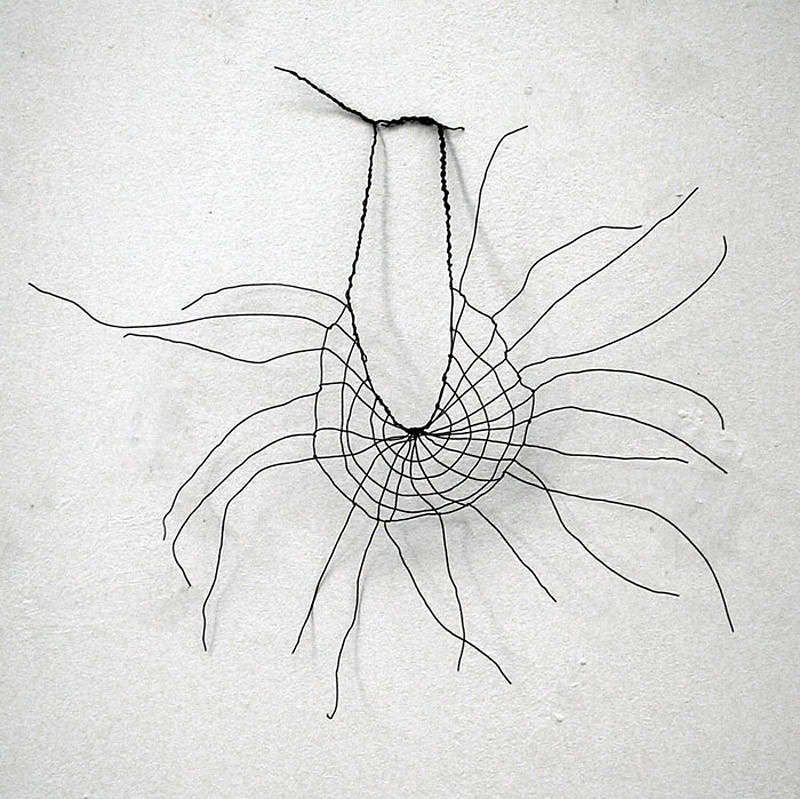
Mari Andrews has been working for over twenty years with materials that some might walk past, not even stopping to think twice about what they are actually seeing. The first time I discovered Mari's work, I connected to a sense of quiet purpose in her work, a sense of doodling with forms and abandoned materials, creating subtle arrangements in space. Her twisted thorns, lichens, and dangling rocks recall the art of ikebana, a quest for balance and beauty. But her formations of silicone coated wires make me think of mindless afternoons sketching, or the curves of the road that lead to Big Sur, also known as the Pacific Coast Highway. It's as if she has created maps with the objects she has discovered upon her own walks and trips, and drew them on the wall for us to use. If these works are maps to an unknown land, you'll see me on the other-side, looking for bubbling fountains and endless mountain views. Thank you Mari......

Mari Andrews' work is part of a summer group exhibition at JK Gallery in Los Angles.
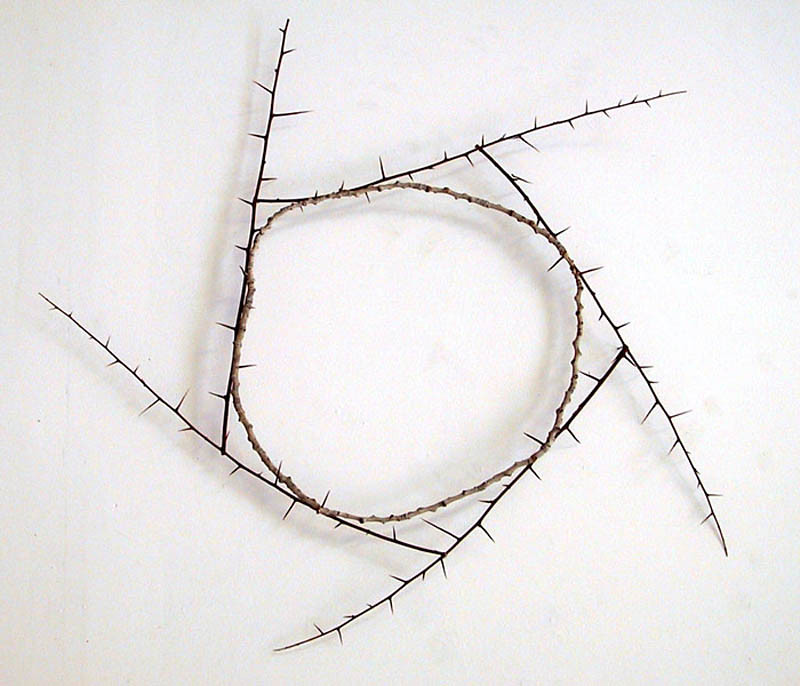


2 untitled works from 2000


Can you talk about your choice of materials you work with for your sculptures? And how they came about?

I work primarily with annealed steel wire which is black. It feels like a pencil line to me. (Almost everything I make I consider to be a continuation of my drawing practice.) Sometimes I add black silicone to the wire, and then it becomes a charcoal line. I combine various man-made and found materials with the wire, to make "hybrids". I have collected found objects for decades and it was very satisfying to bring these objects into the work - a synthesizing Eureka moment actually. Sometimes the collected material will spark an idea for a sculpture. Other times I have a fairly solid concept or drawn-up plans and look about my raw materials to select the right combination of things to carry out that idea. I have also sought out things to make or complete a piece. This is true of the lichen in "Lichen Square" in my upcoming JK Gallery show. I needed a batch of lichen and headed to the Northern California coastal range to collect it.


Where do you collect the materials for your works?

I collect all the time, although I have had to become more discerning for lack of space. I take walks in the city and pick up human detritus from the street. There is rusted metal wire and odd bits on construction and destruction sites, also along railroad tracks. I collect seeds, leaves, pods and branches while hiking, stones while walking river beds, other stuff washes up on coastal shores. I sometimes use kitchen compost like squash or melon seeds, and garden trimmings, too. Once in a great while people will bring me their findings. I take donations .


If you were not a sculptor, you might be.....? A biologist, botanist, geologist, and maybe a sociologist.
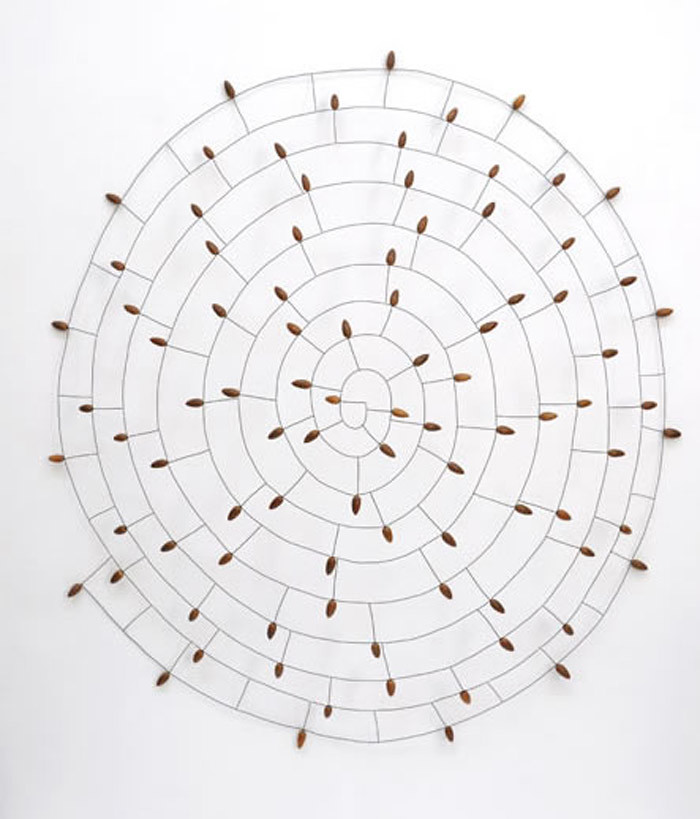


Accoil, 2009, wire and acorns


What does "Acocoil" mean? or "Alphanet"? How do your titles comes about, and what are they referencing?

"Acocoil" is a hybrid of the words Acorn and Coil, I made it up. It is a very basic description of form and materials used in the sculpture. The sculpture "Alphanet" contains 26 manzanita leaves attached to the ends of a wire mesh. Each leaf has an alphabet pasta glued to the face of the leaf. Twenty-five different letters were used with one repeated, so not every letter of the alphabet is represented, one is missing. It couldn't be perfect in my mind, so I made a "purposeful error", like in a Navajo rug. So "Alphanet" is also, a hybrid of a couple of words. I often make up words for titles, sometimes even in fake Latin. I love all those syllables and how they roll off the tongue. I like to misspell words so the title becomes understood phonetically. Other times I use verbs, or descriptive passages, or lines of poetry. Titles come about in many ways.


"For the most part these three-dimensional drawings are presented on the wall. They are made as singular pieces and often come together in larger wall installations. The individual works relate to and play off of each other like words forming sentences or sentences telling a story. "
What are you communicating with your works, what is one of the many stories you are telling?


The quote about "telling a story" is a really a metaphor for the way the sculptures interact with one another. They are like family members, related but different. They can stand alone or be read as a group of "related" elements. When they are presented together I feel that there is a richer, more complete vocabulary of form. I'd like viewers to walk away from my work with a deeper curiosity/observation of one's surroundings. This includes our urban environments as well as the natural ones. Perhaps if we slow down and take in what is around us we will be more inclined to appreciate and protect what we have left of our natural environment. So there is an underlying environmental message.


You mentioned, the objects often times reflect our "human sensitivities and vulnerabilities." Will you talk about this?

I believe that the delicacy and tenderness of some of the materials I use have similar qualities to human emotion, human condition. The objects can be physically fragile; they age, crack, break, fade. Some are sturdy but flexible like the willow. Some are thorny and defensive like cactus spikes. Some look thorny but are soft and pliable - as in silicone. The combination of materials sometimes yield humorous effects - - another very important human quality, I believe. The hundreds of "paperless drawings" I have made are representative of the diversity found in our society; the multitude of people, cultural backgrounds, points of view.


Who or what captivates your attention?
Bees, human psychology, long vistas, my garden, the western state deserts, high altitude streams, liberal politics, petroglyphs, abandoned mines, sense memory, obsolete tools, the oldest living things, spiders, poetry....


Among artists?
Ann Hamilton, Anish Kapoor, Martin Puryear, Gego, Herman de Vries, Terry Winters, Eva Hesse, Kiki Smith.....


Does your work ever frustrate you?
Oh yeah! I'm not technically as proficient as I'd like to be to carry out some ideas. I also find that some ideas are difficult to translate into any materials.


circuit 2006, wire and silicone


please take a look at Mari Andrews' site.

Mari Andrews July 16, 2011 — August 20, 2011
JK Gallery, Los Angeles
2632 S. La Cienega Blvd. Los Angeles, CA 90034


----------------------
forms and functions will change eventually.
white turns to grey turns to black, eventually.


forms and functions will change eventually.
white turns to grey turns
to black, eventually.


1. Luciano Fabro, Volare (Flight), 1988 Marble
2. Lynda Benglis
3. Louise Nevelson


------------------------------------

a slow
long, beautiful
attention to details.


a slow
long, beautiful
attention to details.

images:

1. Roy Arden, trickle down 2010, sculpture

2 Elise Gabriel, at Galerie Gosserez, is a young French designer. Presenting a series of furniture (table, chair and lights) whose main theme is researching Zelfo, a new material composed of cellulose* whose great propensity to reduce, to model itself on curvilinear shapes and to embrace the material, allows it to fit tightly round and to assemble together the elements on which it dries. The extremely radical formatting therefore brings to the forefront all of the material’s mechanical, plastic and symbolic power. (text taken from Galerie Gosserez site!)


----------------


What is Zelfo?


Developed in Austria ten years ago, Zelfo is an innovative and patented material which presents the market with a unique combination of ecological, aesthetic and mechanical properties. It is composed of 100% cellulose fibres, rapidly renewable plant extracts (hemp, miscanthus, etc.) and/or cellulose rich waste, like paper or fabric. Zelfo is therefore 100% biodegradable. On leaving the refining factories, the cellulose fibres are submerged in water: they are filtered; ground; then pressed and dried. Once dried, any finish is possible: Zelfo may be shaped into many forms, whilst still retaining its high density (from 0.5 to 1.5g/cm3) and great resistance, as well as it qualities of delicacy, satin-finish and opalescence.


----------------------------


(let's) B U I L D a space within us....
aka....
attempts to realize "heaven(s) on earth"
""...


.


"If there is a single idea that holds these disparate utopians together, it is the notion of journeying. . . .


They believed that it was possible to redeem oneself by undertaking a journey, that migration in both a physical and a psychological sense could create community.
"


All Things New: American Communes and Utopian Movements, 1860-1914


----------


"...In a lot of ways, my work is a continuation of Modernism. It was artists such as Piet Mondrian and Kazimir Malevich who simplified painting, reduced it to a concept. Then, in America, Minimalism went even further, reducing art to the very object itself.

But the irony is that when you reduce art to that level, then all of a sudden the viewer's attention shifts from the object itself to everything else. What kind of space is it in? What kind of time is it in? So the Minimalists ended up showing the opposite of what they wanted to show.


The aim of my work, from the outset, is to show everything else. The mark on the canvas is a trigger to get the viewer to imagine other things. "
interview with Lee Ufan here...


"Back in the 1970s when space had the American imagination enthralled, figures like Gerard K. O'Neill and Buckminster Fuller began to imagine the next wave of Utopian experiments. Their remarks appear in an amazing book released by And/Or Press and the New Dimensions Foundation in 1978.

These experiments would be attempted with the realization that, if heaven could not be realized on earth,
perhaps it should be put where it belongs: in the heavens. " (here)


------


"If O'Neill wants to build his high-tech space Utopias, his enthusiasm is perhaps exceeded only by Timothy Leary, the psychedelic priest who wants the human race to SMI2LE (Space migration, exponential intelligence, and life extension) by the 21st century. Leary is notable for pointing out that "it will not be the bureaucrats, engineers, and technicians who settle out in space: instead it will be the 'heads'."


In other words, today's counterculture, the drug-taking dharma bums, will be the ones to escape out into space, even as Europe's counterculture sought their own "head trip" in America with Ephrata and the Woman in the Wilderness."

more here


"Leary sees a connection between the 'dropped out', 'freaked out' youth disaffected by the world of the 1970s, and the world-weary, alternative-cosmos-seeking "trippers" of the 1690s.


And are not their California communes and "Jesus freak" tent-cities the first step in the recreation of Paradise, asks Leary?
"


-----------------------


(let's) B U I L D from the space within us....
aka.
attempts to realize "heaven(s) on earth"""...


images:


1. Carlo Scarpa
2. Lee Ufan

3.
Lead pencil studio
4. Mattia Bonetti, via Paul Kasmin Gallery.


------------------
Parallel
Occurrences


Bernd Lohaus 1940–2010


“For the last twenty-one years, I have been working on a self portrait in the form of a building. The building is fiction, but everything inside exists in reality. The building is like a gigantic stage set frozen in time with lots of rooms that all seem as if they have just been abandoned. There is no distinction between works of, let’s say, fifteen years ago and a work I finished yesterday. They are placed in the same time frame. "


-Mark Manders


Parallel
Occurrences


1. Bernd Lohaus (1940–2010) The German artist Bernd Lohaus passed away on November 4 in Antwerp. Lohaus studied at the Dusseldorf Art Academy with Joseph Beuys from 1963 to 1966. From 1964-65 he edited the magazine Happening News with Panamarenko, Hugo Heyman, and Wout Vercammen. While traveling in Spain in 1965, he met the art historian Anny de Decker. They married in 1966 and moved to Antwerp, where they created the gallery Wide White Space in the back of their house.


2. Mark Manders, at Hammer Museuml, Los Angeles now., Parallel Occurrences/Documented Assignments


------------------------
interiors riddling with art
Let's live among history, if only for tonight .


Nothing beats an interior filled with art that commands the space. Personally, living with art & antiques is a top priority. Mindless flipping through the internet this morning produced this top image of a casual loft space.


It always shocks me into a delightful frenzy when I see important sculpture being used in interiors. It's a gamble for sure, but a gamble that we should be willing to take. Thomas Houseago is a Los Angeles sculptor that has deservedly been getting attention for many years now. His earlier shows at David Kordansky (2008) were hunks of material mutated into forms that were hard to ignore. I admit, they kinda left me weak at the knees. Has he left David Kordansky for another L.A. gallery (he seems to be missing from the roster.) ? His recent show in New York at Michael Werner, "the Moon, the Stars, the Sun" can be seen here...


bottle head, from recent show at Michael Werner

Tuf-Cal, hemp, iron rebar


"Thomas Houseago’s figurative sculptures appear physically imposing and powerful in their size and positioning yet fragmented and vulnerable in their construction. To build these works, Houseago begins with a structure of iron rods and then adds a variety of traditional sculptural materials such as plaster, hemp, and wood. Some of his works incorporate graphite or charcoal sketches of faces and anatomy on plaster and wood panels. Monstrous yet unthreatening, this work— a part-human, part-animal being—is in a transitional pose between walking and crawling, weighted on the flat expanses of its plaster hands and feet. Houseago’s combination of sculpting and drawing challenges conventional aesthetic boundaries between three-dimensionality and flatness, monumentality and spontaneity. For the artist, Baby represents a hopeful “beginning,” one that nods affectionately to the riddle about the lifecycle of humans that the Sphinx posed to Oedipus: “What goes on four legs in the morning, on two legs at noon, and on three legs in the evening?”


taken from whitney site here..


interiors riddling with art
Let's live among history, if only for tonight .

------------------------
Our studios were like safe houses.
We could always find shelter there
from various kinds of intrusion.


Dieter Roth, Björn Roth
"Work Tables & Tischmatten"


Hauser and Wirth, New York

His son Björn recalls: 'In the last two decades of Dieter's life, I worked closely with him on art. The studio was at once a workplace and an apartment. There, things flowed together or became isolated. It was a kind of laboratory to search for beauty in nothing, and a workshop for assembling findings. Our studios were like safe houses. We could always find shelter there from various kinds of intrusion. In Mosfellsbær, Seydisfjördur, Hamburg, Basel, Unterterzen and Vienna. Different places and different ambiences, but with one common element: the work tables and Tischmatten.'


go to Hauser and Wirth here..


---------------------
sir
stack
a lot.


sir stack alot.

1. richard shaw, via here
2. noon studio
3. sam moyer, via south willard here.
4. more noon studio, via yatzer, here
Reality lies in the essence of things, and not their external forms. "
- Brancusi


Noguchi later wrote that Brancusi's exhibition made him feel "that everything I had done in my work was false. It filled me with longing to seek after my own true identity."
-Isamu Noguchi


Constantin Brâncuşi
February 19, 1876 – March 16, 1957


"For Brancusi authentic abstraction was a language to express objective
metaphysical fact. Originality consisted in going to the origins, to the mysterious heart
of things. And so he did not see artistic variation as an aim in itself, but, at its most
profound, the natural result of limited beings encountering and expressing expansive
mysteries. “Reality lies in the essence of things, “ he said, “and not their external
forms. Hence, it is impossible for anyone to produce anything real by merely imitating
the external form of an object.” His sculptures were simply an attempt to crystallise
these essences: “The artist should know how to dig out the being that is within
matter,” he affirmed, “and be the tool that brings out its cosmic essence into an actual
visible essence.”

read more here..


"Brancusi might have been mistaken for an unsubtle, instinctive, country-bumpkinish artist. But his work, which was at once fastidious and of a complete simplicity, was the expression of thought-structures, where art and philosophy were concerned, which were in the highest degree lucid, elaborated and profound. The creative vision which underlies his art was highly intellectualized. And yet it was creative, above all things. Brancusi had nothing of what is called ‘culture’ and stood well clear of that soi-disant ‘intellectual life of the day’, which is no more than journalism (or journalism between hard covers). But in other ways he was infinitely more cultivated than the men of letters, the ‘thinkers’, the nonentities who claim for themselves the title of ‘intellectual’ and yet understand nothing, so bemused are they by the slogans, simple or complicated, that they take for the truth, or the production of their own unaided minds. Brancusi could out-master any Master of Arts. He knew all that there was to know about art and its problems. He had assimilated the entire history of sculpture, mastered it, gone beyond it, rejected it, come back to it, purified it, reinvented it. He had got down to its essence."


read more here


Brancusi in his studio...


(Isama Noguchi)
Globular, 1928, polished brass.


"Discontent with academic sculpture, Isamu Noguchi frequented New York's more progressive galleries, and in December 1926 his ambitions were transformed by the exhibition of abstract sculpture by Constantin Brancusi at the Brummer Gallery. Noguchi applied for and was awarded a three-year Guggenheim Fellowship to study modern sculpture in Paris, to be followed by work in India, China and Japan. Soon after arriving in Paris in March 1927 he became an assistant to Brancusi, who taught Noguchi to carve wood and stone. He also drew from the model in the academies, and after leaving Brancusi in late 1927 he established his own studio and created a significant body of abstract drawings and sculpture. Using both geometric and organic imagery, Noguchi made works of bent metal, wood and stone, and experimented with kinetic and neon sculpture. After two years in Paris his fellowship was not renewed, and he returned to New York in early 1929."


read more here about Noguchi and Brancusi...
via Noguchi Museum...
good
face...
1950-2009


good
face.


the images:
1. guido gambone
2. gilbert portanier
3. marguerite wildenhain
4. matthew ronay
5. mai brun
6. ruby neri
monday
morning
minerals
and
magic.


"The way that I approach making certain artworks is to have some kind of psychological position, a place that is grown from a certain ambiguity. You always have to think about materials in terms of being real things – you have to cut them off from what their real use is, to interfere in their world-ness. You have to start from this material basis, and understand yourself through the material – it gives you a means of detachment."


-Roger Hiorns
(read conversation here.)


"You have to believe
We are magic
Nothing can stand in our way
You have to believe
We are magic
Don't let your aim ever stray"

-Olivia Newton John


"SEIZURE
was Roger Hiorns’ most ambitious work to date and his first major sculptural project within an urban site, and it marked a radical shift in scale and context in his work. The artist encouraged the growth of an unexpected crystal form within a low-rise late-modernist development near the Elephant & Castle in south London."


contemplating the earth.
formations and light.


1. danel richter, c/o contemporary art daily.
2. carol bove, here...
3. carlee fernandez.... here
4. and 5. willy daro lamps here, via artnet...
6. ado chale. here.
7. roger hiorns, seizure.... here.


"Ms. Pergay's work falls somewhere between art and design, but she insisted
that she is neither an artist nor a designer. Instead, she explained, she envisions a finished object, making a quick sketch and then charming someone else into constructing it."
from here..


(sconce, 1968)


Maria Pergay. 1930

French designer Maria Pergay (b. 1930) has been creating innovative, contemporary objects, furniture, and decoration for the past fifty years. From Paris to Saudi Arabia to Russia, her sophisticated designs fashioned from iron, silver, steel, or bronze have earned her a coveted following among the most influential, iconic, and fascinating personalities of her time, including Pierre Deshays (President of Maison Jansen), Salvador Dalí, Pierre Cardin, King Fahd, and numerous others.