
"I want to be different from those rules; I want to be F R E E. "
"It’s important to think about holding back and stopping to think, to be quiet, and to think of ourselves as part of the universe. Humans shouldn’t be at the center of it. And we should be more reflective about who we are and what we do."
- Lee Ufan (here)
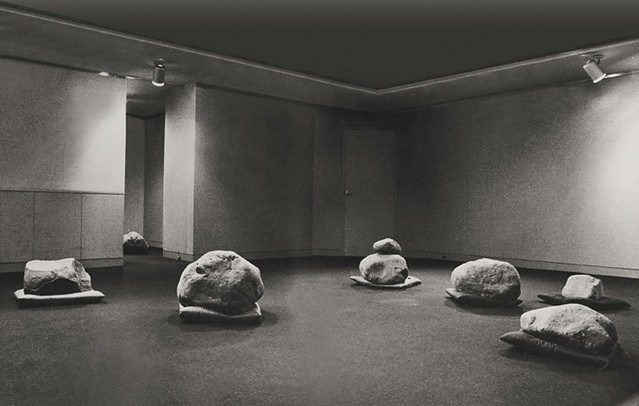
Top Image: Relatum, 1971, cushions, stone, and light (top image, Lee Ufan)
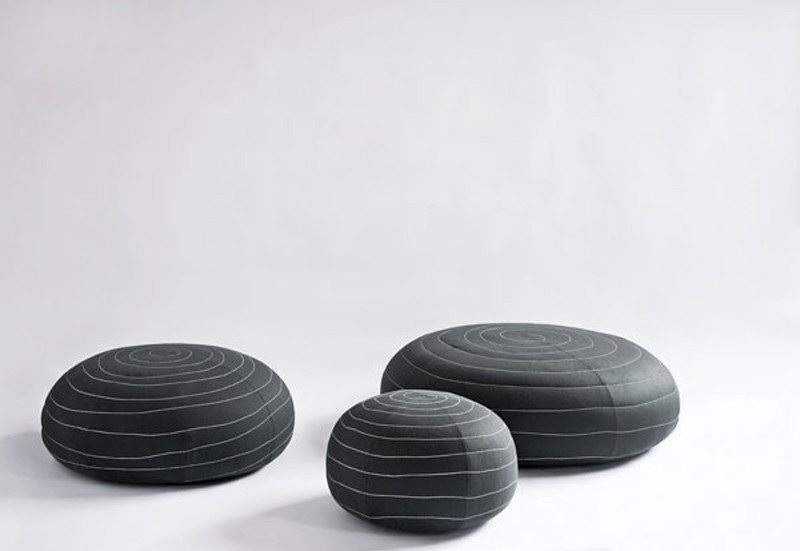
Bottom Image: 2011 Ottomans for the Home."Generous and rounded shapes characterized by visible “random” stitching. Soft and playful whirls with an almost hypnotic effect available on different sizes and colors.
I don’t make just massive objects; I create space. - Lee Ufan
I feel lucky that I was able to experience Lee Ufan's works shown in the gigantic-walled boxes of Blum and Poe in Los Angeles. (see show here) It was one of those rare exhibitions that I continued to think about for months. Perhaps it was the perfect day to have an "encounter with the otherness" which Lee Ufan defines " in a very normal way, such as when people meet other people, or when we see the moon, or when you meet a beautiful woman, or an encounter with an incident. In fact, it starts with facing each other, which is simultaneously a passive and active encounter." Yes indeed, his work is hard to describe, as words sometimes fail, where images do not. His work provided a place to rest the mind that rainy morning when I first encountered it. The rocks, trapped in walled white boxes, homes for a moment to objects pulled from the earth.
How can our public spaces provide "encounters with the otherness." Can space transform us permanently into a new mindset? As I think about his work on the 4th of July weekend, his work takes on a whole new meaning. That my friends, is another story.
To those in New York, Lee Ufan's work is at the Guggenheim until September 28, 2011. Please visit the site here for more details.
- David John
-------------------------
Lee Ufan: "To look at modern art needs knowledge. We require knowledge of history to understand classical art. If we do not know about Christianity and Greek mythology, we cannot understand western art. When I just look at the painting itself, I cannot understand it at all, it requires a broad depth of prior knowledge. Modern art also has many rules and artists are creating works by using those rules. I want to be different from those rules; I want to be free. This is why I want to have reactions from African, American, European and Asian people encountering my work like, “Wow, what is it?” The meaning does not matter, but I want to have these fresh moments; they are very important for me."
(LEE UFAN 李禹煥 Conversation between Lee Ufan, Karlyn De Jongh & Peter Lodermeyer Lee Ufan studio, Paris, France, 16 January 2009)
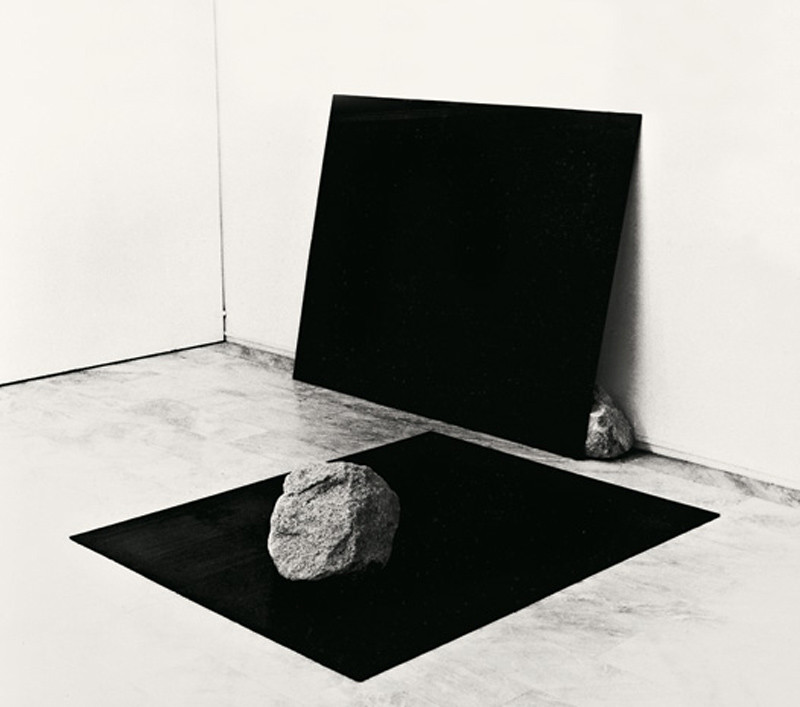
Relatum, 1978, Steel and Stones
"Lee constructs an aesthetic system that challenges the closed object-hood of modern art. He eschews objective form for a relational structure and spatial dynamic that induces us to encounter the bare existence of what is actually before us, to focus on "the world as it is." He promotes these mutual relationships between work, viewer, and surroundings by shifting the artist's role from an act of creation to a practice of mediation. Rooted in his philosophical stance and going beyond the binaries of Eastern and Western aesthetics, Lee's art and writings partook of the radical global rethinking that transformed contemporary art in the 1960s and 1970s, when terms such as "system," "structure," and "process" recast the object as a dynamic event occurring outside the studio confines in everyday time and space. His sculptures were shown in several group exhibitions at Tokyo's leading galleries and museums in the late 1960s and 1970s, a period when he also began presenting his work in Germany and France. Coincidental with the early recognition of his work in Europe, Lee's minimalist, systematic paintings gained critical praise both in Tokyo and Seoul, where he became a seminal figure in the Korean monochrome school."
(taken from here)
1st and 3rd image taken from Guggenheim.
The 2nd image is :SPIN by Mârten Claesson, Eero Koivisto, Ola Rune taken from Orange Skin in Chicago, here...


