Arshile Gorky

a sandwich
and some
painting.


I got called into jury duty today.
Museums are free to downtown Los Angeles jurors...
Off to MOCA for the new retrospective during my lunch break!

I know so little about Arshile Gorky, excited to see this show.


--------


Arshile Gorky (b. c.1902, Khorkom, Armenia; d. 1948 Sherman, Conn.)
was a seminal figure in the movement toward abstraction that transformed American art in the middle of the 20th century. Born in an Armenian village on the eastern border of Ottoman Turkey, Gorky was a first-hand witness to the Turkish government's Armenian Genocide of 1915, which led the artist’s family and thousands of others to flee.

In 1920, Gorky emigrated to the United States and eventually settled in New York, where he became a largely self-taught artist. At a time when the American avant-garde privileged originality over traditional working methods, Gorky was a nonconformist who developed his personal vocabulary through a series of intensive apprenticeships to the styles of other artists, including Paul Cezanne, Pablo Picasso, Fernand Leger, and Joan Miro, before developing his own unique and deeply influential visual language in the early 1940s.


MOCA GRAND AVENUE
250 South Grand Avenue
Los Angeles, CA 90012


------------------------------

John Baldessari (for the phone)

"When someone completes their own still life using In Still Life 2001-2010 it becomes their own artwork," says artist John Baldessari.
"It's not mine. It's theirs. Still lifes are about the fleeting things in life...


THE ORIGINAL IN STILL LIFE
John Baldessari created the first In Still Life in 2001 for an exhibition at LACMA. He hung Abraham van Beyeren's Banquet Still Life on the wall next to an empty frame and invited exhibition visitors to digitally rearrange or remove the 38 objects in the original 17th-century Dutch painting, thus creating a new still life of their own. Visitors were encouraged to print out their still lifes and hang them in the room or take them home. When someone completed a still life using In Still Life, it became his or her own artwork, not John Baldessari's or Abraham van Beyeren's artwork.


---------------------


John
Baldessari
here...

It's official!

a chapter
ends

another
one opens!


To all those (I'm sorry!) who heard me talking endlessly
about selling my home, the endless showings, and the crazy bank delays.
It's finally over. Its official! A new chapter of my life is beginning, and
I'm on a total adrenaline rush today.


the fireplace, 1908, original tile, and floors.


--- --- --- --- ---


The fireplace of the home I used to own.
A wonderful 1908 house that I restored for the past 8 years here in Los Angeles.

Repeat... I used to own!
It's sold to an amazing new owner.


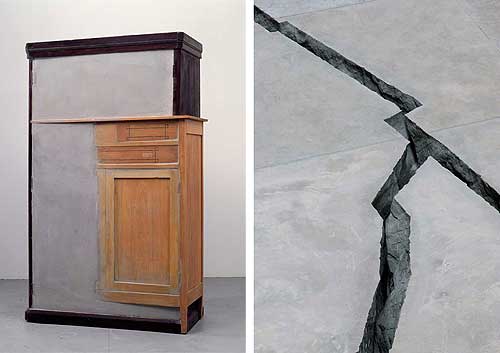
the kitchen corner cabinet...
ugh, want to fill these up with concrete!
and pretend i had doris salcedo over for tea...


---------------------------

Scott Burton

taken from NY TIMES,
an obituary by Roberta Smith.

Jan 1, 1990.


Scott Burton, an American sculptor whose work balanced stubbornly and elegantly between art and furniture while evolving into a new kind of public sculpture,
died of AIDS on Friday at Cabrini Medical Center in New York City.

He was 50 years old and lived in Manhattan.


By the end of his life, Mr. Burton's simple yet eye-catching benches, stools and chairs, cut from smooth and sometimes jagged pieces of granite, could often be found with people sitting on them in several North American cities, including Seattle, Cincinnati, New York City, Portland, Ore., and Toronto.

---------


Mr. Burton, a small, wiry man known for his erudition, verbal precision and explosive laugh, worked as a critic and an editor for Art News and Art in America before becoming a full-time artist. He emerged in the late 1960's and early 70's as part of an artistic generation that came of age in the shadow of Minimalism.


Uncertain that his passion for furniture and design could ever lead to an artistic career, he turned to literature, obtaining an B.A. from Columbia in 1962 and an M.A. from New York University in 1963. By the mid-60's he was working regularly as a freelance critic for Art News, then under the editorship of Thomas B. Hess.

Elizabeth C. Baker, the editor of Art in America and formerly the editor of Art News, worked with Mr. Burton at both publications. ''As a critic his enthusiasms were passionate, his dislikes were categorical,'' she said. ''He wrote as he would later cut granite, with high style, great clarity of form and a very sharp edge.''


At the end of his life, Mr. Burton's interests in dissolving the boundary between art and design took him into the curatorial realm. Last spring, at the invitation of Kirk Varnedoe, the director of the department of painting and sculpture at the Museum of Modern Art, he organized an exhibition of Brancusi's works at the museum.

In it, some of Brancusi's bases were exhibited on their own, as sculptures in their own right, a treatment that outraged some critics, while impressing others.


The art historian Robert Rosenblum said of him yesterday: ''Scott was as singular and unique as a person as he was as an artist. His fiercely laconic work destroyed the boundaries between furniture and sculpture, between private delectation and public use and radically altered the way we see many 20th-century masters, including Gerrit Rietveld and Brancusi.''


-------------------------------

L I G H T

new work: Heather Carson
light/ALBERS
"

at ACE Gallery,
Los Angeles


I have sought to createlight as a visceral, active presence that has its own logic and structure, co-existing with the action – often in conflict – not there simply to better “see” what is happening onstage.”"


For Carson, each light piece is not a direct reference to an individual Albers painting but to the oeuvre at large. Albers carefully noted on the reverse side the type and shades of color that he used as a record of the works specific formal experiment. Mirroring the foregrounding of the electrical systems in her work, bringing the 'background' information forward rather than hiding it, each piece lists the colors of the fluorescent tubes in the title, i.e. light/ALBERS: Cool White/DESIGN 50/ADV850, using the manufacturers name for the color temperature of the tube. Albers himself used different types of fluorescent lighting in his studio (some that cast warm tones, and some cool tones) that allowed him to assess the color interactions in different lighting environments.


Historically, fluorescent works have tended to use the fixture itself as the carrier of the electrical wires. In the new Light Action wall sculptures on view, the heavy industrial aesthetic of her armatures and their joints may seem unfamiliar as part of an artwork. But Carson has developed a highly refined aesthetic over the years encompassing conduit and the use of indoor and outdoor electrical fittings.

The use of aluminum pipe and Speed-Rail enables her to place lights in space; adjacent to each other but maintaining their individual structural integrity.


new work: Heather Carson
light/ALBERS
"

at ACE Gallery,
Los Angeles


-----------

no sign, no signal

new york:
Alexander May

curated by

Sarah Walzer
July 1 7-10.


new york:
Alexander May

curated by

Sarah Walzer
July 1 7-10.

45 Canal Street, New York


---------------------------------

when sculptures become cabinets

1966
and 1968

when sculptures
become cabinets


"a wall for apricots"


"rolling stones"


when sculptures become cabinets.
two masters working in parallel voids.

1. Anne Truitt, 1968, a wall for apricots.
2. Ettore Sottsass, Cabinet," rolling stones" 1966


----------------------------------

Radical Potential In Absolute Illumination.

"In 1912, Scheerbart published The Light Club of Batavia, a Novelle about the formation of a club dedicated to building a spa for bathing—not in water, but in light—at the bottom of an abandoned mineshaft.

Translated here into English for the first time, this rare story serves as a point of departure for Josiah McElheny, who, with an esteemed group of collaborators, offers a fascinating array of responses to this enigmatic work.
"


The Light Club: On Paul Scheerbart's
"The Light Club of Batavia"

by Josiah Mcelheny, here...


"the universe is far too rich and complex to be comprehended by reason alone.

Only naive wonder — the basis of the sublime —
could promote the development of higher forms of understanding."


-Paul Scheerbart


Paul Karl Wilhelm Scheerbart (8 January 1863 in Danzig – 15 October 1915 in Berlin) was an author of fantastic literature and drawings.

He was also published under the pseudonym Kuno Küfer and is best known for the book Glasarchitektur (1914).
Scheerbart's fantasty essays about glass architecture influenced architects at that time, including the young Bruno Taut.


Scheerbart published a long succession of fantasy novels, articles, and poems between 1889 and his death in 1915, in which he insisted that the universe is far too rich and complex to be comprehended by reason alone. Only naive wonder — the basis of the sublime — could promote the development of higher forms of understanding."


-------------------------------