Showing posts with label robert morris. Show all posts
Within the ‘labyrinth’
a paradox is allowed:
we lose ourselves to find ourselves.


Robert Morris
LABYRINTH

"A full scale labyrinth installation by Robert Morris is on view at Sonnabend Gallery in the courtyard. Robert Morris has said of his labyrinth works: “The labyrinth is a form that recedes back beyond memory. And it seems to have been a kind of metaphysical architecture, one that was never actually built in ancient times but rather inscribed in petroglyphs, or stamped in coins, and later manifested in mosaics or depicted in paintings. Beyond its origins being shrouded in the unrecoverable past, its function in ancient times remains a subject of endless speculation. Metaphors rise and fall here; labyrinthine meanings are reflected in the form itself.” “I think of Wittgenstein’s remark about how language is a labyrinth of paths; approached from one side one loses one’s way. So too forming with the non-linguistic can become labyrinthine, coherent from one side, not from another. Within the ‘labyrinth’ a paradox is allowed: we lose ourselves to find ourselves."


-----------------
i wanted you to feel the same

Robert Morris
vs
Olivie Mourgue

"Olivier Mourgue created an entire natural landscape with rivers, carpets that ressembled earth- grass- and other natural floor coverings, modular movable rooms."
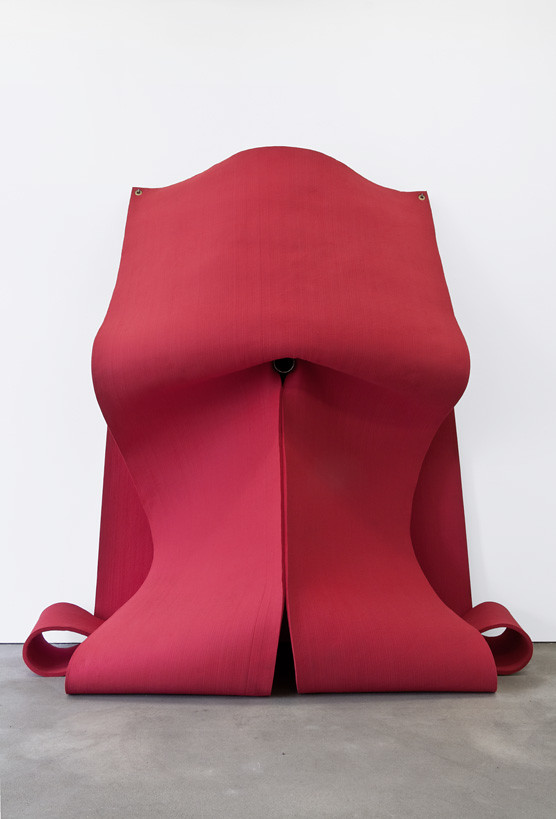


I was totally unaware that Robert Morris was still making these felt works. Yesterday I received an email with this 2010 image from Sprüth Magers in Berlin: long draping felt, heavy, substantial curves that make me weak at the knees. For those heading to Basel next week, Sprüth Magers is in Hall 2.0 | Booth B 9. Curious to know if there will be more felt works there.


------------------


"A certain mental energy and obsessive, single-minded concentration, bordering on a kind of possession, is addressed to questioning the premises of sculpture. This goes along with an increasing negativity toward and incapacity for personal relations. I move further into a kind of semi-autistic space which excludes the other. Such a space is familiar from childhood where it was constantly denied. Only the inanimate object is alive for me in these years, and making objects becomes my bulwark against the threat of the other, and every other is regarded as threatening, especially those who would try to get close to me. But I want more than the object. I want a totalizing, enclosing space within which I exist with the object. I want to fashion a conceptual, mental, psychological and physical space. I want to make a world within which I alone move amongst my objects."

-
Robert Morris interview... please read the entire interview here.


--------------------------


Olivier Mourgue
's most fabulous yet most unknown complete interior design project was made for Visiona by Bayer AG. From 1968 until 1972 (estimate), Bayer AG hired the most talented designers to create an entire futuristic display on board of a ship in Cologne, Germany. Each year, a different designer was hired. Joe Colombo made Visiona in 1969. Verner Panton made Visiona in 1970, Olivier Mourgue made Visiona in 1971 and as far as we know, Jack Lenor Larsen created the last Visiona, either in 1972 or 1974. in 1971, Bayer AG hired Olivier Mourgue for the complete interior installation of Visiona.

During Visiona, Olivier Mourgue created an entire natural landscape with rivers, carpets that ressembled earth- grass- and other natural floor coverings, modular movable rooms. It was the most relaxing environment that was ever created during Visiona. Olivier Mourgue who had always been very close to nature, tried and successfully succeeded to implement nature in most of the Visiona. The Visiona of Olivier Mourgue was a Utopia where man and nature lived side by side in peace.

It was a wonderful experience to be there at that time and Olivier Mourgue's Visiona was one of the most memorable interior installations that were ever created. In 1976, Olivier Mourgue closed his studio in moved to Bretagne, France where he became a professor at the school of Fine Arts in Brest. Olivier Mourgue currently lives Plouguiel, a small town in Bretagne, France. Every once in a while he displays his art in Brest, France.


text taken from here. please read more here...


----------------------
The stupid mistake of letting go....
(do you know what I mean)


It's a question of lust
It's a question of trust
It's a question of not letting
What we've built up
Crumble to dust
It is all of these things and more
That keep us together


Independence
Is still important for us thought (we realise)
It's easy to make
The stupid mistake
Of letting go (do you know what I mean)


The stupid mistake of letting go....
(do you know what I mean)


1. Wade Guyton, 2007, Epson ink, from the upcoming Phillips de Pury Auction.
2. Madeleine Dietz, more works here...
3. Robert Morris, Felt, 1974


lyrics by Depeche Mode "A Question of Lust."


--------


Earth is my working and construction material , it can be found everywhere in almost inexhaustible quantity. Earth is the ground where things grow, the ground where things can live, fertile ground. Earth is the ground that can be worked and cultivated, but that is also wasted, spoil, that is exploited ruthlessly. Earth is also the fertile sediment of decomposed organic matter. Earth in combination with water is moldable, spreadable, flows, dries up, forms cracks – breaks into pieces. The sun that makes the earth dry up simultaneously provides vital light. Earth, deliberately not mixed with binders, which throughout the process always remains the same, that is earth.”


Madeleine Dietz : 1997


--------------------


"when formless becomes attitude"

"It was already quite dark in the fully packed salon.
The monstrous furniture melted to formless masses."
Franz Werfel, Buenos Aires 1941


Lothar Windels, 2000

Joseph


Robert Morris, 1983,
House of the Vetti


I'm currently absorbing the book, "FORMLESS FURNITURE" edited by Peter Noever. A fantastic history of art furniture! This is the catalog from the 2008 MAK show in Vienna. Take a look at the show here.... Here's an excerpt from the catalog....

"While Robert Morris created well-publicised works of art from thick felt, he did no more than accept the material, barely recontextualizing it as "fine art."

German designer Lothar Windels's felt armchair created in 2000 is an explicit reference to Beuys, Windels called his furniture by the artist's biblical name, JOSEPH. For his opulent object, Windels treated his material in a literally rapturous fashion. A 12 meter long and approximately, three centimeter thick felt path was folded into a seat with armrests, combined with a somewhat shorter second path that was turned over into a backrest and affixed with three long metal screws...."


------------------------------