Showing posts with label jean royere. Show all posts
Galerie Chastel-Maréchal, Paris

"Aline Chastel is currently exhibiting a range of pieces by artists
who also worked as interior designers during the 1930s, ‘40s and ‘50s"
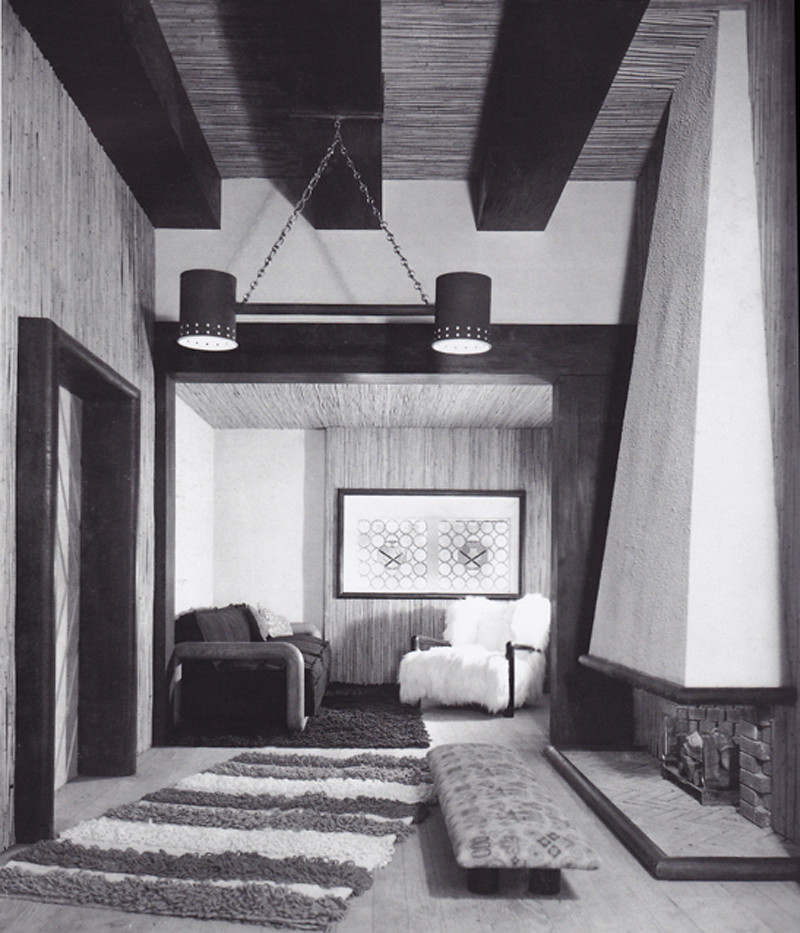


"The Galerie Chastel-Maréchal focuses on the promotion and re-discovery of important twentieth century French designers, in particular those working between 1930 and 1960. The range of artists represented provides a cogent overview of this period, and many of the works shown are extremely rare and have never previously been seen on the art market.

Aline Chastel is currently exhibiting a range of pieces by artists who also worked as interior designers during the 1930s, ‘40s and ‘50s. These include the unusual creator Line Vautrin, who became famous in the 1950s for her incredible mirror-sculptures, Serge Roche, known for his baroque-inspired creations, not to mention Jean Royère, Jacques Quinet, Gilbert Poillerat, Jean-Charles Moreux, André Borderie, Georges Jouve, Alexandre Noll and André Arbus."


-----------------

portrait of the "modern" office
the essentials: lighting, desk, and a chair.


portrait of an office
the essentials: lighting, desk, and a chair.


1. Michael Anastassiades, via the fantastic MATTER. NY. gold plated brass, silken wire
2. Jean Royere, 1948 desk.
3. India Mahdavi chair, her designs are in a range all her own. Vibrating on their own.


more information on Jean Royere's desk:

"Jean Royère was a self-taught designer who began working on interiors in 1931. By the 1940s he was achieving major international success, particularly in the Middle East. Following the opening of his first gallery in Paris in 1942, he opened branch offices in Cairo in 1946 and in Beirut in 1947. Royère designed this desk for his own study in 1948, at a time when his practice was flourishing.

The lattice that forms the outer frame of the desk is a signature component in much of Royère's furniture. One of his most recognisable designs was the 'Eiffel Tower' pattern, a black lattice with gold balls at the intersections, which was used for items ranging from wall lamps to tables. He also designed wooden and rattan pieces using lattice patterns, and a range of furniture entitled Croisillons - 'Lattices' - incorporating metal lattices painted in bright colours."


taken from V of A museum Collection.
spend a day there, your mind will thank you.


-------------------------
you go your way.
i'll go my way.

(and we'll meet in the middle, someday.)


you go your way.
i'll go my way.

(and we'll meet in the middle, someday.)


images:

1. Jean Royere. andiron
2. Christopher Kurtz. go here... for more info!


Jean Royere, (taken from Galerie Patrick Seguin, here..)

"In 1931, aged 29, Jean Royère (1902-1981) resigned from a comfortable position in the import-export trade in order to set up business as an interior designer. He learnt his new trade in the cabinetmaking workshops of the Faubourg Saint-Antoine in Paris. In 1934, he signed the new layout of the Brasserie Carlton on the Champs Elysées and found immediate success.

This was the beginning of an international career that was to last until the early 1970s. A key figure of the Avant-garde in the 1950s, Royère tackled all kinds of decoration work and opened branches in the Near East and Latin America. Among his patrons were King Farouk, King Hussein of Jordan, and the Shah of Iran, who were captivated by his freedom of creation and his elegance and entrusted him with the layout of their palaces.

Royère pioneered an original style combining bright colors, organic forms and precious materials within a wide range of imaginative accomplishments. In 1980, he left France for the United States, where he lived until his death."


-----------------------

humps,
and bumps!
oh my!


Jean Royere:
humps,
and bumps!
oh my!


1. Andiron, 1950 Wrought iron.
2. “Serpentin” wall light
, ca. 1945, Painted tubular metal, paper shades


p.s. the new
philips de pury catalog
is stunning!


-------