Showing posts with label art. Show all posts
"I like to think of my work as a threshold between
in and out, object and space, heavy and light."

- Peter Shelton


Peter Shelton: eyehand
Selected sculpture from 1975 - 2011 at L.A. Louver, Los Angeles
19 November - 30 December 2011


"A lot of my early work started off nominally geometric and constructed, but I would sneak in a reference to the body without depicting the body, which was a way of creating a kind of subversive connection. Desire, memory, humor, even wistfulness are powerful psychic qualities that I do not avoid. I wanted to enter the work directly and have its narrative understood as much in the body as the mind."

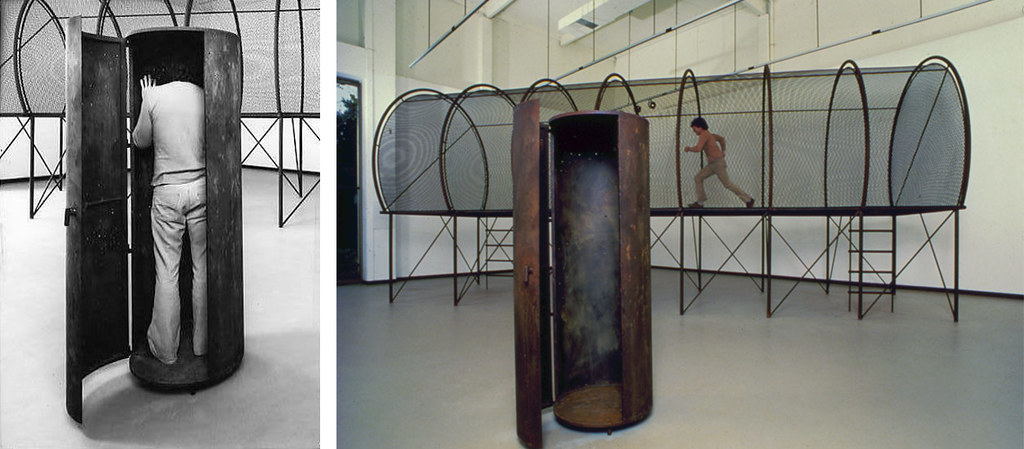
"I like to think of my work as a threshold between in and out, object and space, heavy and light. You can see a preoccupation with the piercing of a membrane as a theme in flattop, 1975, with its overhead plane extended endlessly by mobility of it wheels. holecan, 1980 is an anthropometric planetarium of perforations. And recently blackslot, 2008-10 pushes its elusive objectified inner out to its edges where its containing skin defuses into an indefinite surface bleeding off into space.

-- Peter Shelton


Born in 1951, Peter Shelton was a pre-medical student at Pomona College, studying sociology, anthropology and theatre, before he switched to major in fine art. Shelton went on to earn a trade certificate in welding from the Hobart School of Welding Technology in his hometown of Troy, Ohio, in 1974, and a MFA from the University of California Los Angeles in 1979.

more here....

YHBHS interview with MARI ANDREWS

....
"I often make up words for titles, sometimes even in fake Latin. I love all those syllables and how they roll off the tongue. I like to misspell words so the title becomes understood phonetically. Other times I use verbs, or descriptive passages, or lines of poetry. Titles come about in many ways."

- Mari Andrews


the studio of Mari Andrews....


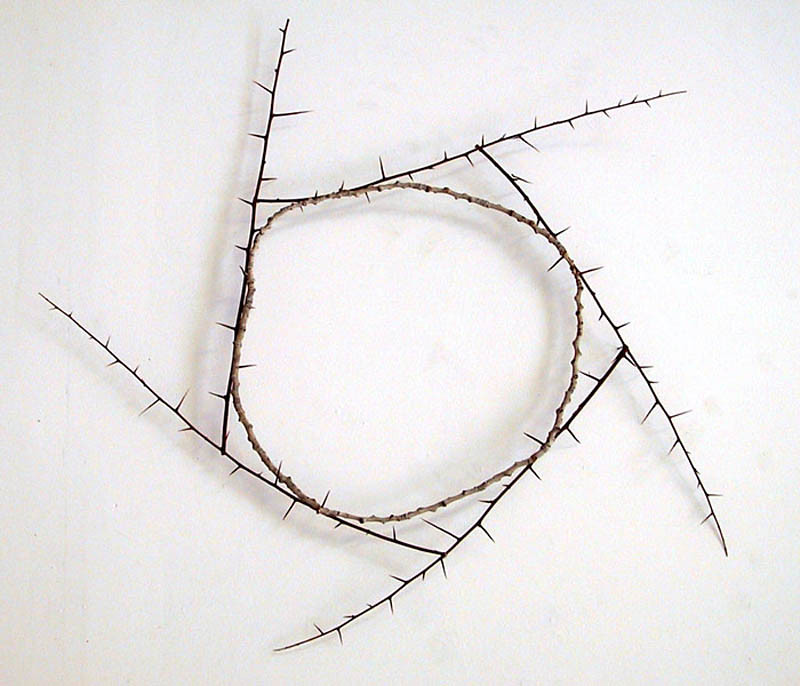
Mari Andrews has been working for over twenty years with materials that some might walk past, not even stopping to think twice about what they are actually seeing. The first time I discovered Mari's work, I connected to a sense of quiet purpose in her work, a sense of doodling with forms and abandoned materials, creating subtle arrangements in space. Her twisted thorns, lichens, and dangling rocks recall the art of ikebana, a quest for balance and beauty. But her formations of silicone coated wires make me think of mindless afternoons sketching, or the curves of the road that lead to Big Sur, also known as the Pacific Coast Highway. It's as if she has created maps with the objects she has discovered upon her own walks and trips, and drew them on the wall for us to use. If these works are maps to an unknown land, you'll see me on the other-side, looking for bubbling fountains and endless mountain views. Thank you Mari......

Mari Andrews' work is part of a summer group exhibition at JK Gallery in Los Angles.


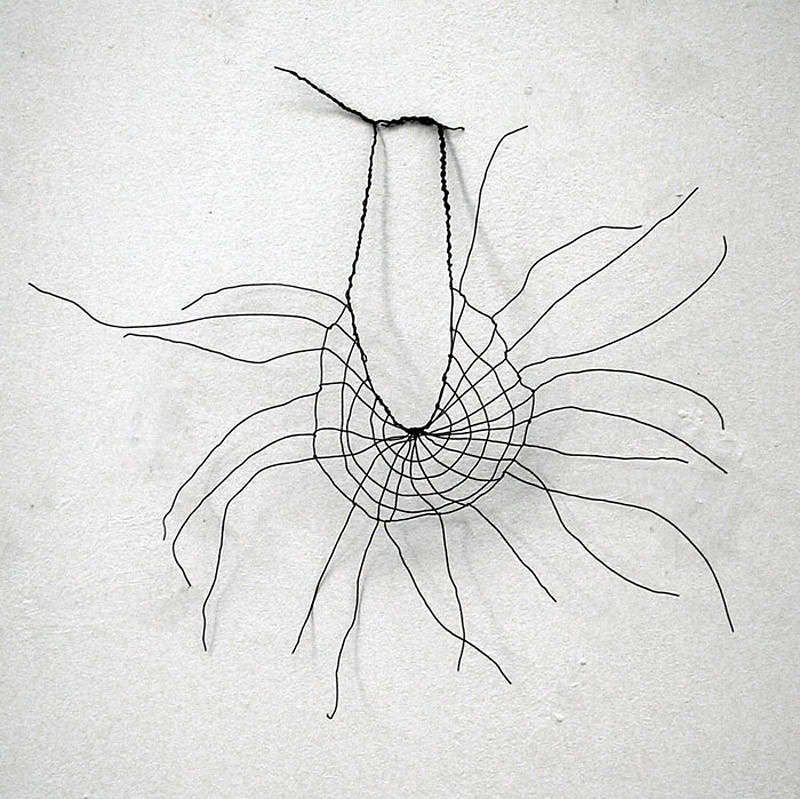
2 untitled works from 2000


Can you talk about your choice of materials you work with for your sculptures? And how they came about?

I work primarily with annealed steel wire which is black. It feels like a pencil line to me. (Almost everything I make I consider to be a continuation of my drawing practice.) Sometimes I add black silicone to the wire, and then it becomes a charcoal line. I combine various man-made and found materials with the wire, to make "hybrids". I have collected found objects for decades and it was very satisfying to bring these objects into the work - a synthesizing Eureka moment actually. Sometimes the collected material will spark an idea for a sculpture. Other times I have a fairly solid concept or drawn-up plans and look about my raw materials to select the right combination of things to carry out that idea. I have also sought out things to make or complete a piece. This is true of the lichen in "Lichen Square" in my upcoming JK Gallery show. I needed a batch of lichen and headed to the Northern California coastal range to collect it.


Where do you collect the materials for your works?

I collect all the time, although I have had to become more discerning for lack of space. I take walks in the city and pick up human detritus from the street. There is rusted metal wire and odd bits on construction and destruction sites, also along railroad tracks. I collect seeds, leaves, pods and branches while hiking, stones while walking river beds, other stuff washes up on coastal shores. I sometimes use kitchen compost like squash or melon seeds, and garden trimmings, too. Once in a great while people will bring me their findings. I take donations .


If you were not a sculptor, you might be.....? A biologist, botanist, geologist, and maybe a sociologist.


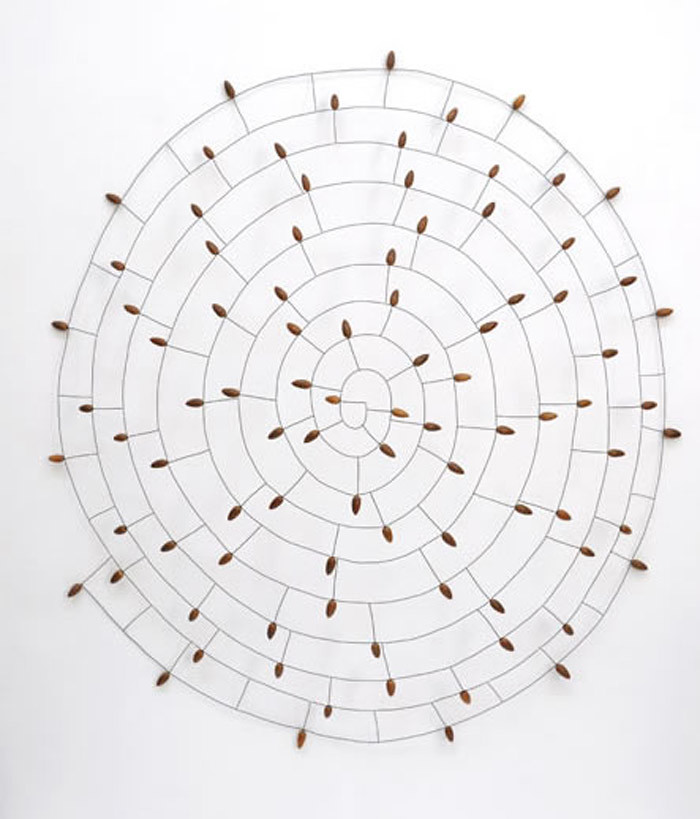
Accoil, 2009, wire and acorns


What does "Acocoil" mean? or "Alphanet"? How do your titles comes about, and what are they referencing?

"Acocoil" is a hybrid of the words Acorn and Coil, I made it up. It is a very basic description of form and materials used in the sculpture. The sculpture "Alphanet" contains 26 manzanita leaves attached to the ends of a wire mesh. Each leaf has an alphabet pasta glued to the face of the leaf. Twenty-five different letters were used with one repeated, so not every letter of the alphabet is represented, one is missing. It couldn't be perfect in my mind, so I made a "purposeful error", like in a Navajo rug. So "Alphanet" is also, a hybrid of a couple of words. I often make up words for titles, sometimes even in fake Latin. I love all those syllables and how they roll off the tongue. I like to misspell words so the title becomes understood phonetically. Other times I use verbs, or descriptive passages, or lines of poetry. Titles come about in many ways.


"For the most part these three-dimensional drawings are presented on the wall. They are made as singular pieces and often come together in larger wall installations. The individual works relate to and play off of each other like words forming sentences or sentences telling a story. "
What are you communicating with your works, what is one of the many stories you are telling?


The quote about "telling a story" is a really a metaphor for the way the sculptures interact with one another. They are like family members, related but different. They can stand alone or be read as a group of "related" elements. When they are presented together I feel that there is a richer, more complete vocabulary of form. I'd like viewers to walk away from my work with a deeper curiosity/observation of one's surroundings. This includes our urban environments as well as the natural ones. Perhaps if we slow down and take in what is around us we will be more inclined to appreciate and protect what we have left of our natural environment. So there is an underlying environmental message.


You mentioned, the objects often times reflect our "human sensitivities and vulnerabilities." Will you talk about this?

I believe that the delicacy and tenderness of some of the materials I use have similar qualities to human emotion, human condition. The objects can be physically fragile; they age, crack, break, fade. Some are sturdy but flexible like the willow. Some are thorny and defensive like cactus spikes. Some look thorny but are soft and pliable - as in silicone. The combination of materials sometimes yield humorous effects - - another very important human quality, I believe. The hundreds of "paperless drawings" I have made are representative of the diversity found in our society; the multitude of people, cultural backgrounds, points of view.


Who or what captivates your attention?
Bees, human psychology, long vistas, my garden, the western state deserts, high altitude streams, liberal politics, petroglyphs, abandoned mines, sense memory, obsolete tools, the oldest living things, spiders, poetry....


Among artists?
Ann Hamilton, Anish Kapoor, Martin Puryear, Gego, Herman de Vries, Terry Winters, Eva Hesse, Kiki Smith.....


Does your work ever frustrate you?
Oh yeah! I'm not technically as proficient as I'd like to be to carry out some ideas. I also find that some ideas are difficult to translate into any materials.


circuit 2006, wire and silicone


please take a look at Mari Andrews' site.

Mari Andrews July 16, 2011 — August 20, 2011
JK Gallery, Los Angeles
2632 S. La Cienega Blvd. Los Angeles, CA 90034


----------------------
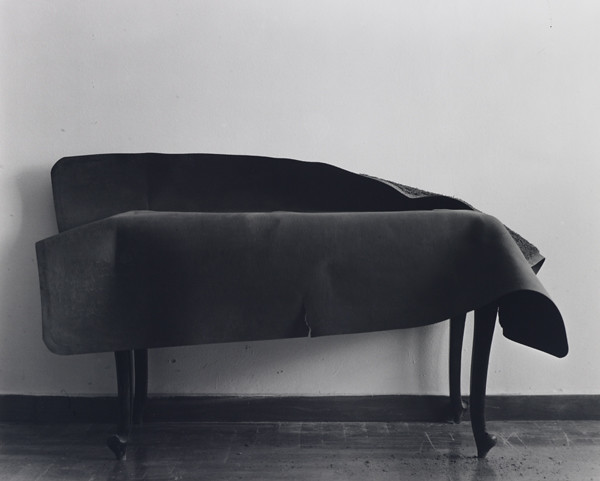
"I believe that meanings in sculpture emerge more powerfully
when they are carried through sculpture's own silent language"


Becky Beasely

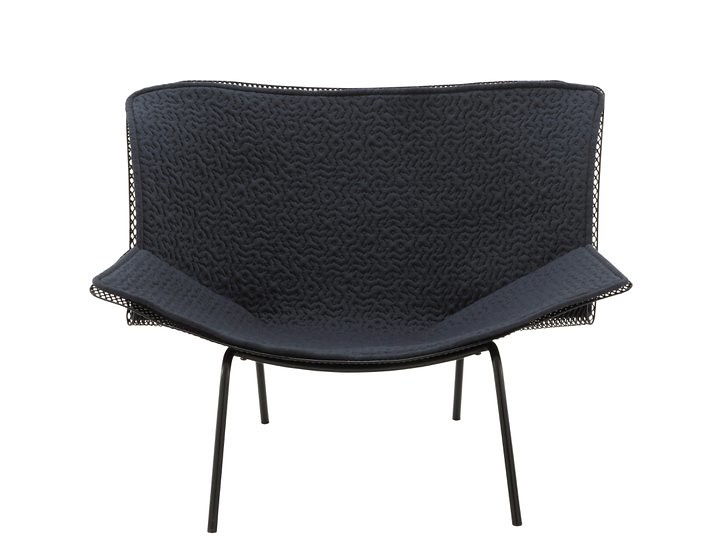
vs
Francosi Azambourg

"for tonight, we will hold each other until dawn"


grillage:

1. A framework of heavy timbers, steel, or reinforced concrete beams laid longitudinally and crossed by similar members laid upon them to spread a heavy load over a larger area, esp. for use where the ground is not firm.

2. A series of steel beams, bolted together and placed over a footing; used to distribute a concentrated column load over the top of the footing.


--------------


"If human beings respond so decisively to mood and environment, and also to space and proportion in architecture, then it is possible to, and imperative that we should, rediscover those perceptions in ourselves, so that architecture and sculpture can in the future evoke those definite responses in human beings which grew with Venice and still live to-day. Sculpture should act not only as a foil to architectural properties but the sculpture itself should provide a link between human scale and sensibility and the greater volumes of space and mass in architecture."

"In opposition to 'social realism' I believe that meanings in sculpture emerge more powerfully when they are carried through sculpture's own silent language; and that if the sculptor himself can find personal integration with his surroundings and his community his work will stand a greater chance of developing the poetry which is his free and affirmative contribution to society."

"So many ideas spring from an inside response to form: for example, if I see a woman carrying a child in her arms it is not so much what I see that affects me, but what I feel within my own body. There is an immediate transference of sensation, a response within to the rhythm of weight, balance and tension of the large and small form making an interior organic whole. The transmutation of experience is, therefore, organically controlled and contains new emphasis of forms. It may be that the sensation of being a woman presents yet another facet of the sculptural idea."

-Barbara Hepworth


-------------------

an unknown lamp
vs
a certain desire to transcend(ed) material

I didn’t want to work with the truth in materials, except in a limited way...


I no longer contain the information, the work does.


I don’t like material as such, whether it’s oil paint or anything else, because it leads you into a trap.
The trap is that materials, in themselves, present a certain truth which one has to work with. I didn’t want to work with the truth in materials, except in a limited way. The paper curls because it comes on a roll, and I don’t mind that. It can have that much license but not too much more, because I'm interested in the ways in which I can experience myself, and my work is really about making myself.

Yet it isn’t possible for me to work without materials. There are some artists whose work I admire who don't use materials as such, but that’s not the way I think. Among the various levels of thought, the visual is paramount. So, when it came to dealing with materials, I chose paper because it has no weight and isn't a bother to store: all practical reasons. Also, I didn't want to manufacture antiques and I like its impermanence.

Materials present situations which are unexpected, and I enjoy that. It is possible to think things out before hand and know the answers, but the materials will then present unknown visual systems that could not have been anticipated. It is a kind of dialectic: I have an idea and the material; then I put them together, and it is always dreadful—invariably it’s just dreadful. There is a separation between the idea, the materials, and me. The work is there, so it’s a matter of understanding all aspects more clearly. How to bring it together? It is taken down and put up several times. When near completion, it’s as though the work and I exchange places; I no longer contain the information, the work does. Then there is a process of small adjustments, to make the ideas and the process more cogent.


Dorothea Rockburne
, an interview from ARTFORUM 1972.

image is unknown image taken from EBAY. color bleached out. faded. sold to unknown purchaser. it's the life of a lamp, man.


----------------------------
James Siena @ the pace gallery, ny
Mar 25, 2011 - Apr 30, 2011

“all work is an affirmation of being human, of being in this particular container [the body] with locomotion and holes for intake and output […]; motif and variation are placeholders, in part for the architecture of my consciousness, and ideally they are on a steadily rolling feedback loop."


For those in New York, or passing through, James Sienna is showing new works at Pace Gallery. His abstractions have melted my mind for quite sometime. Reminiscent of the mazes I would draw in grade school, attempting to pass the time quietly. 20 years later, I'm still looking for these mind puzzles, in rugs, in parking lot structures, in floorplans, or in my coffee grounds. Abstraction and geometric puzzles, a place to pass the time quietly.
Most on enamel, his surfaces are really the draw. The brushstrokes are gentle and vivid, and need to be seen by the human eye to be fully appreciated.


"James Siena
is known for his unique process, creating intricate geometric abstractions driven by predetermined self-imposed sets of rules, or “visual algorithms.” By establishing a basic unit and action and repeating it ad infinitum, Siena allows the unpredictability of his self-generated system to govern the final outcome of his complex picture plane, while still maintaining the presence of the artist’s hand. The exhibition features twenty-three new glossy enamel on aluminum paintings, and thirty works on paper; together, the painstakingly crafted works demonstrate that even a small change to an initial variable produces vastly different end results.

As Siena’s repeating patterns, sequences, curves, loops, and interlocking combs entwine and unwind, his abstractions become matrices for investigations into liminality and mutate into biomorphic forms.

Siena once explained that “all work is an affirmation of being human, of being in this particular container [the body] with locomotion and holes for intake and output […]; motif and variation are placeholders, in part for the architecture of my consciousness, and ideally they are on a steadily rolling feedback loop.”


works and text above by james sienna, sourced from the pace gallery


in sequence:
1. triangle sequence path (second version), 2011 graphite and ink on abacá paper
2. Two Sequences, 2009 enamel on aluminum


--------------------
forms and functions will change eventually.
white turns to grey turns to black, eventually.


forms and functions will change eventually.
white turns to grey turns
to black, eventually.


1. Luciano Fabro, Volare (Flight), 1988 Marble
2. Lynda Benglis
3. Louise Nevelson


------------------------------------

IAN McDONALD

"Wearing"
@ Rena Bransten Gallery, SF
March 17 - April 23, 2011


"Ian McDonald’s exhibition, Wearing, refers to the displays of non-functional ceramic objects hung, assembled, or arranged to evoke clothing or containers re-configured for puzzling purposes. As in past bodies of work, multiple forms in different sizes and shapes are grouped to suggest mass produced items of quotidian or even specific functionality – in this case, “things” that are worn down or out or hung up to be worn later."


"The hardness of fired clay makes it difficult to relate the hanging forms to “things worn” or to imagine what their industrial use might be, but McDonald has long enjoyed stretching the possibilities of both forms and functions. His title urges viewers to process the physical inventory and its functions as a mental exercise, but otherwise, to enjoy the shapes, colors, and arrangements for the aesthetic harmonies they may suggest. "


for all those in SF, go see this show!
plus upcoming interview with Ian on YHBHS.


Rena Bransten Gallery
77 Geary Street
(between Kearny and Grant Streets)
San Francisco, CA 94108

----------------------
Sheila Hicks: 50 Years,
March 24 – August 7, 2011

"Hicks's exceptional body of work blurs boundaries between art, design, and architecture just as deftly as it crisscrosses cultures. "


The Institute of Contemporary Art (ICA) presents Sheila Hicks: 50 Years, the first major retrospective to honor this extraordinary American artist. Sheila Hicks has built an international reputation with her two- and three-dimensional works in fiber. Her remarkably far-reaching artistic focus has encompassed painting, sculpture, photography, weaving, fabric design, writing, publishing, teaching and collaborations with architects. Her early work of the 1960s was at the forefront of experimentation in sculpture. By the 1980s it had taken hold. Since that time, her unique work has explored the dynamic interactions of color and the skills required to hone an aesthetic vision in multiple media.

Featuring more than 90 of her most important works, including a major installation of a work on loan from Target's headquarters in Minneapolis displayed in an entirely new iteration, this exhibition offers insight into Hicks's thinking, her processes, and her approach to materials, both fibers and found objects. The project reveals the continuities between the artist's small weavings, and free-standing wrapped sculptures, and a colossal 20-foot high work suspended from ceiling and cascading from wall.

Hicks's exceptional body of work blurs boundaries between art, design, and architecture just as deftly as it crisscrosses cultures.


-------------------------------------------

T H E W A L K.

walking sticks: the path.

"it has no front nor back, no bottom nor top
but offers itself to multiple presentations instead"


walking sticks: the path.

1. Andre Cadere (I continually find myself coming back to this work. a work that was transported to a gallery that it might not have been invited to. a true wallflower. aren't the wallflowers always the most interesting ones at the party anyhow?)

2. COMMUNE created these walking sticks for ACE Hotel and Swim Club. They are hand made for the stylish hiker. They are a limited run so only available while they last. go here..


"Cadere referred to his wood bars as “peinture sans fin” – “unlimited painting” – which redefined the boundaries of the medium and broke with traditional ways of seeing. The form of the rod does not prescribe a privileged point of view – it has no front nor back, no bottom nor top – but offers itself to multiple presentations instead: The bars can be laid out on the floor, fixed to the wall or can lean against it; they can also, theoretically, be moved from one place to another.

The aspect of mobility plays an important role in Cadere’s conceptual approach: In his “promenades-performances”, the artist walked – bar in hand – through the urban context, “occupying” with it public spaces (such as the street, the subway or a restaurant) and thus demonstrating the relative independence in the presentation of his art from the institutional context. At the same time, Cadere attended – whether invited or not – openings of gallery and museum exhibitions (such as, for instance, in 1972 documenta 5), in order to present his wood bars and get the public involved in discussions about his work."

(andre cadere text via here....)


enjoy your walk, or as ROLU might say,
please enjoy the time as it passes.
--------------------------


Upon his return from the exhibition,
the young artist vowed to become a “modern” artist. "

Stuart Davis, 1913


Stuart Davis (1892-1964)

Torso and Head of Two Figures, 1928 Ink and pencil on paper


"In 1913, he was invited to participate and attend the International Exhibition of Modern Art (also known as the Armory Show). Davis later recalled that he was “enormously excited by the show” and was deeply affected by the post-Impressionist works by Gaugin, Van Gogh, and Matisse that were on display. Upon his return from the exhibition, the young artist vowed to become a “modern” artist. "


(from here)


American landscape 1932


"Gloucester … was the place I had been looking for. It had the brilliant light of Provincetown, but with the important additions of topographical severity and the architectural beauties of the Gloucester schooner. The schooner is a very necessary element in coherent thinking about art. I do not refer to its own beauty of form, but to the fact that its masts define the often empty sky expanse. They function as a color-space coordinate between earth and sky … From the masts of schooners the artist eventually learns to invent his own coordinates, when for some unavoidable reason they are not present."


-Stuart Davis


----------------------
wolfgang tillmans
at LACMA


Wolfgang Tillmans, go here...
Wednesday, March 9 | 6:30 pm

"Wolfgang Tillmans is known for photographs that appear casual, authentic, and immediate. Constantly shifting in scale and subject, his work explores the nature of the medium: exploiting numerous formats (Polaroid, Xerox, inkjet) and presentation styles. Whether pinned to the wall or on the pages of a book, Tillmans's imagery is at once very personal and embedded in contemporary culture, politics, and art history."

This lecture is a collaboration between the Wallis Annenberg Photography Department, the USC Roski School of Fine Arts, and the Otis College of Art and Design, Fine Arts Department.


(thanks rodney!)


----------------------
the dense fog
of the california coast
in the fall is intoxicating.
(hyper sun in shy November)

aka "the dense decorator"


the dense fog
of the california coast
in the fall is intoxicating.
(hyper sun in shy November)

aka "the dense decorator"


1. Dagobert Peche, lamp, circa1915
2. Mari Eastman, Moonscape with Fo-Dog 2010 Flashe, oilstick, ink, White-out, spray-paint, acrylic, glitter on canvas with painted canvas fringe, via Cherry Martin
3. Lecia Dole-Recio, new work at Richard Telles now!


Dagobert Peche was born 1887 in St.Michael, Salzburg. After studying Architecture in Vienna at Ohmann Peche turned to interior design, or one can call it in
a better way to "mise en scéne" of entire rooms.

The heritage of secessionist surface decoration and the example of artists from the Viennese School of Applied Arts (Kunstgewerbeschule) are clearly visible. 1911 Peche got acquainted with Josef Hoffmann, he worked for the firms of Johann Backhausen, Philipp Haas, Wiener Keramik, Viennese porcellain manufacture, Josef Böck.
Peches concepts present the glaring opposite to the reduced forms of Hoffmann.


With his "female decoration of rooms" Peche creates his specific way of interior design that can be described as "public intimacy".


------------------------------
Parallel
Occurrences


Bernd Lohaus 1940–2010


“For the last twenty-one years, I have been working on a self portrait in the form of a building. The building is fiction, but everything inside exists in reality. The building is like a gigantic stage set frozen in time with lots of rooms that all seem as if they have just been abandoned. There is no distinction between works of, let’s say, fifteen years ago and a work I finished yesterday. They are placed in the same time frame. "


-Mark Manders


Parallel
Occurrences


1. Bernd Lohaus (1940–2010) The German artist Bernd Lohaus passed away on November 4 in Antwerp. Lohaus studied at the Dusseldorf Art Academy with Joseph Beuys from 1963 to 1966. From 1964-65 he edited the magazine Happening News with Panamarenko, Hugo Heyman, and Wout Vercammen. While traveling in Spain in 1965, he met the art historian Anny de Decker. They married in 1966 and moved to Antwerp, where they created the gallery Wide White Space in the back of their house.


2. Mark Manders, at Hammer Museuml, Los Angeles now., Parallel Occurrences/Documented Assignments


------------------------
Bojan Šarčević
Comme de chiens et des vagues
13 October – 13 November, 2010


She, 2010, onyx


via Modern Art London


"Occupying a room to itself is a sculpture carved from a large single block of Persian onyx. To acquire the stone, Šarčević travelled to the ancient Silk Route city of Yazd in central Iran, from where the block of raw stone was transported by road to Britain for carving and finishing. Precisely worked with rectangular, square cut shapes and cavities, it suggests a semi-functional form, while its sensuous materiality and ambiguous purpose lends a disquieting presence.

The interplay of shape and man-made geometry effects properties of change and transformation, while revealing the fundamentally unchanged and highly aesthetic qualities of this rich and elemental material. Its presence offers a constant reflection on sculptural tensions: fragility and resilience, weight and gravity, shape and texture, geometric and organic form, organic and mineral flesh."


from here...


Bojan Šarčević

Comme de chiens et des vagues
13 October – 13 November, 2010
Rachel Lachowicz
vs
Craig Kauffman

C A L I F O R N I A


"Rachel Lachowicz is known for turning her witty eye on the masculine-centric world of Modernism and for making radical incursions into the canon of art history by reconfiguring famous works. She falls under a multitude of headings: feminist, appropriationist, post minimalist, conceptual artist, and conceptual sculptor."


--------------


“California was never ashamed of being a new society."

- Richard Armstrong,
director of Guggenheim
Museum


Rachel Lachowicz
vs
Craig Kauffman


"Mr. Kauffman’s early paintings were critical in defining this new style. Mr. Plagens called them “the first evidence of a Los Angeles sensibility.”

Mr. Kauffman’s later work blazed splashier trails, as he experimented with the effects of light on works that were painterly yet three-dimensional. “The true power of what he did was his incorporation and then redirection of light inside sculpture,” said Mr. Armstrong, who was the curator of a show of Mr. Kauffman’s work at the Whitney Museum of American Art in 1987.

“Many of them glowed,” he said. “Others were translucent. Even the supposedly opaque had a noteworthy shimmering quality to them.”


taken from here...


-------------------

a painting.
a box.
a witch.
a hidden melody.


a painting.
a box.
a witch.
a hidden melody.


1. marcel eichner, no shirt, no shoes, no service, 2010
2. max frisinger, sealion (feist)


----------------------------------
when paintings
become buildings.


when paintings
become buildings.


1. Conrad Marca-Relli, 1913 - 2000, painter
2. Coop-Himmelblau, go here!, Los Angeles, High School. From my office chair, I can see this high school!

"The future society will be a society of knowledge. We believe that the knowledge of the future will not be found within closed disciplines any more but rather at the intersection points between different fields of knowledge, such as the sciences, arts, economics and ethics. Timely education for the future therefore has to offer possibilities of crossings between different fields of knowledge.

This is where High School #9 positions itself as a new flagship high school which includes the arts in public education and offers courses in the visual and performing arts next to the general education of language, mathematics, sciences and history. "


------------------------------
Albers!

Prefatio

Preface


Josef Albers
(1888-1976)

“Prefatio”
1942 Ink on graph paper
Signed and dated lower right


"In this auction we are offering a unique example of one of Josef Albers rarest graphic works. Once more the optical illusion created in “Prefatio” from 1942 (Lot 28, Estimated at $5,000-7,000) precedes the optical styles of Victor Vasarely, Bridget Riley, and other Op Artists by 25 years. Notably, this example was a gift to James Prestini on the occasion of Prestini’s successful curated show on Albers work held at Texas Teachers College in 1942."


Current LAMA Auction.
Go read the blog here!


-----------------------------------
Re-Dressing,
Sept 15, 2010


Richard Aldrich John Armleder Hope Atherton Justin Beal Avner Ben-Gal Cecily Brown Daniel Buren Tom Burr Shane Campbell Dan Colen Jessica Craig-Martin Simon Denny Roe Ethridge Gardar Eide Einarsson Ryan Foerster Michel François Piero Golia Mark Hagen Thilo Heinzmann Thomas Helbig Patrick Hill Jonathan Horowitz Jacqueline Humphries Piotr Janas Rashid Johnson Jeff Kessel Scott King Terence Koh Alex Kwartler Sean Landers Hanna Liden Antoni Llena Nate Lowman Adam McEwen Jonathan Meese Tim Noble and Sue Webster Luigi Ontani Peter Peri Jack Pierson Mika Rottenberg David Salle Bojan Sarcevic Agathe Snow Dash Snow Billy Sullivan Emily Sundblad Patrick Tuttofuoco Gary Webb Eric Wesley Aaron Young


Bortolami
520 W 20th Street

(between 10th and 11th Avenues)
here.....


--------------------------------
Fall Calender:
Art/ Design opening

"Autumn Suite"
at SPECIFIC!


Brooks' store rocks! Excited to see this upcoming show!

September 4th, 2010, 5-8 PM to celebrate the start of the season. Introducing new furniture designs by Jalal Poehlman and sculpture and painting by Sean Brian McDonald

Featuring new case goods and lighting by favorite SPECIFIC designers Marie Christophe, todosomething, WORKSTEAD, Scout Regalia and Atelier Takagi...
uh huh!


7374 Beverly Blvd Los Angeles,
CA 90036 323.930.0220 store


------------------------------